
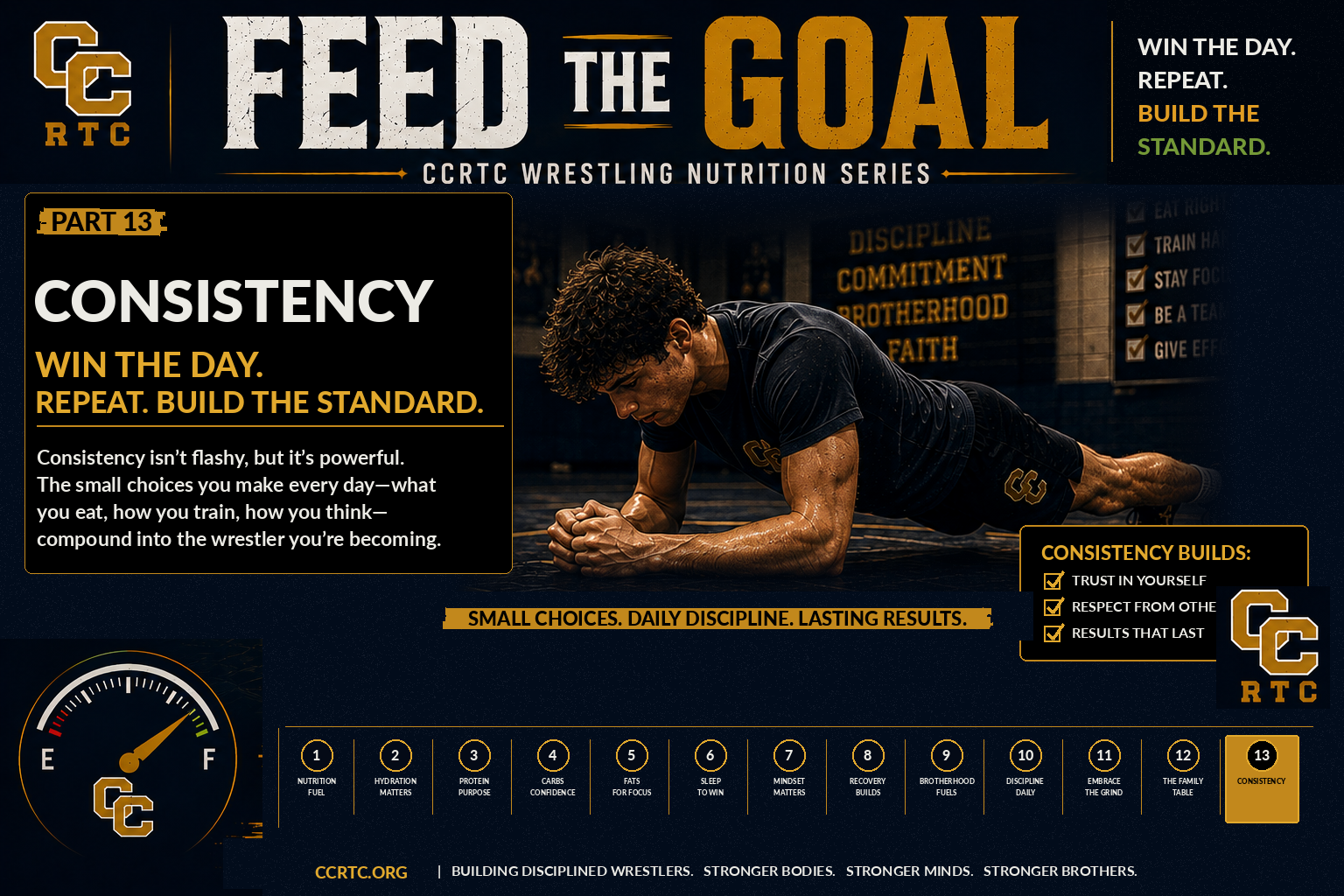
Feed the Goal – Part 13: Consistency
Small Habits. Extraordinary Results.
Throughout the Feed the Goal series, we have spent considerable time discussing individual pieces of wrestling nutrition and performance. We have talked about offseason growth, preseason preparation, weight management, post weigh-in recovery, competition-day fueling, hydration, supplements, recovery, travel, parents, and even the importance of the family table.
Each topic is important on its own.
But none of them works particularly well without consistency.
That may be the least exciting lesson in this entire series, but it may also be the most important. Wrestlers are naturally attracted to things that promise noticeable results. A new strength program feels exciting. A new supplement creates curiosity. A difficult workout provides immediate satisfaction because the athlete can feel what they accomplished.
Consistency is different. Most days, it does not feel extraordinary at all.
It looks like eating breakfast again. Filling the same water bottle again. Going to bed on time again. Packing food for another tournament. Choosing recovery when friends want to stay up late. Eating the meal that supports your goal when something less useful would taste better in the moment.
None of those choices wins a championship by itself.
Repeated often enough, however, they help build the wrestler who can.
Greatness Usually Looks Boring
There is a tendency to imagine elite athletes living dramatically different lives from everyone else. In reality, many of their most important habits are surprisingly ordinary.
They eat.
They hydrate.
They sleep.
They train.
They recover.
Then they do it again.
What separates them is often not that they discovered something nobody else knows. It is that they continue doing the things everyone else already knows they should be doing.
A wrestler who follows an excellent nutritional plan for three days and abandons it for the next four is unlikely to receive much benefit. The same is true of hydration, sleep, strength training, and recovery. Performance does not respond particularly well to occasional enthusiasm.
It responds to repeated behavior.
This is why consistency should be viewed as a skill.
Like a takedown, it becomes more reliable through repetition.
Small Decisions Accumulate
One missed breakfast probably will not determine the outcome of a season. One late night will not destroy an athlete’s development. One poor meal will not erase months of training.
That is important to understand because perfection is neither realistic nor necessary.
The problem begins when exceptions quietly become habits.
Consider how seemingly insignificant choices can accumulate:
- Skipping breakfast occasionally becomes skipping it most mornings.
- Going to bed late on Saturday becomes staying up late throughout the week.
- Forgetting a water bottle becomes regularly arriving at practice underhydrated.
- One convenience-store meal becomes an entire travel weekend of poor nutrition.
- Missing one recovery day becomes training through constant fatigue.
Each individual decision may appear harmless.
The pattern is what matters.
The opposite is also true. Good decisions accumulate just as powerfully. A healthy breakfast eaten hundreds of times matters. An extra hour of sleep repeated throughout a season matters. Consistent hydration matters. Packing appropriate food for every tournament matters.
The wrestler experiences the result long before anyone can identify the individual decisions that created it.
Wrestling Is a Compounding Sport
Improvement in wrestling rarely arrives all at once.
A young wrestler may practice a technique for months before it suddenly begins working in competition. Strength develops slowly. Conditioning improves gradually. Match awareness grows through hundreds of situations experienced over years.
Nutrition works much the same way.
The benefits of good nutrition are rarely found in a single meal. They appear through better practices, improved recovery, healthier growth, greater strength, and more consistent energy over time.
The same principle applies throughout this series.
Part 1 did not suggest that one protein-rich dinner builds muscle. It discussed creating an offseason environment that consistently supports growth.
Part 7 did not suggest that drinking a bottle of water before practice solves hydration. It emphasized daily habits.
Part 9 did not argue that one good night’s sleep creates recovery. Recovery becomes meaningful when athletes repeatedly protect it.
The lesson is the same everywhere:
What you repeatedly do matters more than what you occasionally do exceptionally well.
Motivation Is Useful, But Unreliable
Young athletes often believe they need to feel motivated before making good decisions.
That is backwards.
Motivation comes and goes. Some mornings an athlete will be excited to train. Other mornings they will not. Some evenings going to bed early will feel easy. On others, friends, phones, games, and social activities will be far more attractive.
A lifestyle cannot depend upon feeling motivated every day.
Routines solve that problem.
When habits become established, fewer decisions need to be made. Breakfast is simply something you eat. The water bottle goes to school because that is where it goes. Recovery happens because it is part of training. Food is packed before a tournament because, as discussed in Part 10, the tournament is a business trip.
The athlete no longer renegotiates the goal every morning.
That creates freedom.
Routine Reduces Decision Fatigue
Teenagers already make hundreds of decisions every day. School, friendships, homework, practices, social media, and family responsibilities constantly compete for attention.
Good routines reduce the number of decisions that require willpower.
A wrestler who has established habits does not repeatedly ask:
- Should I eat breakfast today?
- Should I bring water?
- Should I pack food for the tournament?
- Should I recover after practice?
- Should I stay up another hour?
Those questions have largely been answered in advance.
This is one reason the family environment discussed in Parts 6, 11, and 12 matters so much. When healthy food is already available, water is normal, family meals are consistent, and sleep is protected, the athlete does not have to fight the environment every day.
Good culture makes consistency easier.
Parents Build the Environment Where Consistency Lives
Parents cannot wrestle the matches for their children, but they can make disciplined living considerably easier.
Part 6 described this as shared commitment. Part 11 examined the parent’s role more directly, and Part 12 brought those ideas to the family table.
Consistency connects all three.
Parents influence grocery shopping, meal schedules, transportation, bedtime routines, travel planning, and household culture. None of those responsibilities requires perfection. What matters is creating an environment where the athlete’s goals are supported more often than they are challenged.
That may mean having appropriate food available after practice. It may mean protecting bedtime on school nights. It may mean packing a cooler before leaving for a tournament instead of relying upon whatever food happens to be available.
These choices may seem small to adults.
To an athlete trying to remain consistent, they can make an enormous difference.
Coaches Reinforce What Families Build
Coaches also play an important role in consistency.
A coach cannot control everything an athlete does outside the wrestling room, but coaches establish expectations. When hydration, recovery, preparation, and proper nutrition are discussed as normal parts of wrestling rather than optional extras, athletes begin treating them that way.
Good coaches reinforce predictable behaviors:
- Arrive prepared.
- Train with purpose.
- Hydrate.
- Recover.
- Take care of your body.
- Return ready to work again.
The goal is not to create athletes who occasionally produce extraordinary effort.
The goal is to create athletes who can repeatedly produce quality effort.
Consistency makes that possible.
Consistency Is Not Perfection
This distinction matters.
A disciplined lifestyle should not become an obsessive one.
Birthdays happen. Vacations happen. Holidays happen. Athletes occasionally stay up too late, eat something that does not fit the plan, forget their water bottle, or simply have a bad day.
That does not mean the plan failed.
As discussed in Part 11, parents should be careful not to create anxiety around food or performance. Part 12 likewise emphasized protecting joy around the family table.
Consistency allows flexibility precisely because the foundation is strong.
A wrestler whose habits are good most of the time can enjoy a celebration without guilt. The problem is not the occasional deviation from the plan.
The problem is when the deviation becomes the plan.
Instant Gratification Competes With Long-Term Goals
Teenagers live in an environment built around immediacy. Entertainment is available instantly. Food can be delivered almost instantly. Social media provides constant stimulation. Friends can communicate at every hour of the night.
Athletic development operates on a completely different timeline.
Muscle takes time.
Technique takes time.
Recovery takes time.
Healthy body composition takes time.
Confidence takes time.
Consistency requires accepting that today’s disciplined choice may not produce a visible reward tomorrow.
That can be difficult, especially for young athletes. It is also one of the most valuable lessons wrestling can teach.
Delayed gratification is not simply a nutrition skill.
It is a life skill.
The Same Principle Applies When Nobody Is Watching
Tournament days are easy places to feel committed. Coaches are present. Teammates are nearby. Parents are watching.
The harder moments usually occur somewhere else.
They occur Tuesday morning at breakfast.
Wednesday night at bedtime.
Friday afternoon when friends want fast food.
Sunday when recovery feels less exciting than another workout.
Those choices rarely receive applause.
They are also where much of the advantage is created.
Wrestlers eventually learn that discipline is not primarily something performed in front of other people.
It is what happens when nobody is paying attention.
Consistency Protects Athletes From Panic
One of the greatest benefits of consistency is that it reduces emergencies.
Part 2 discussed arriving at the season prepared rather than panicked. Part 3 emphasized making weight without sacrificing performance. Part 7 described hydration as a daily habit rather than a last-minute rescue. Part 10 emphasized planning ahead when traveling.
All of these ideas share the same principle.
Preparation removes panic.
An athlete who consistently manages nutrition and hydration does not need desperate solutions before weigh-ins. A family that consistently plans tournament travel does not need to search for acceptable food at the last minute. An athlete who consistently recovers does not need to repair weeks of accumulated fatigue before an important tournament.
Consistency keeps small problems small.
Feed the Goal
There is no single meal that creates a champion.
There is no supplement that replaces preparation.
There is no workout that compensates for months of poor habits.
Great wrestlers are built through thousands of ordinary decisions made with extraordinary consistency.
Eat well most of the time. Hydrate every day. Protect sleep. Recover with purpose. Prepare before travel. Lean on the family and coaches who support the goal, and learn to make those decisions increasingly for yourself.
Do not chase perfection.
Build patterns.
Because eventually those patterns become habits, those habits become a lifestyle, and that lifestyle begins showing up on the mat.
Feed the goal.
Consistency is how the goal becomes reality.







One Comment