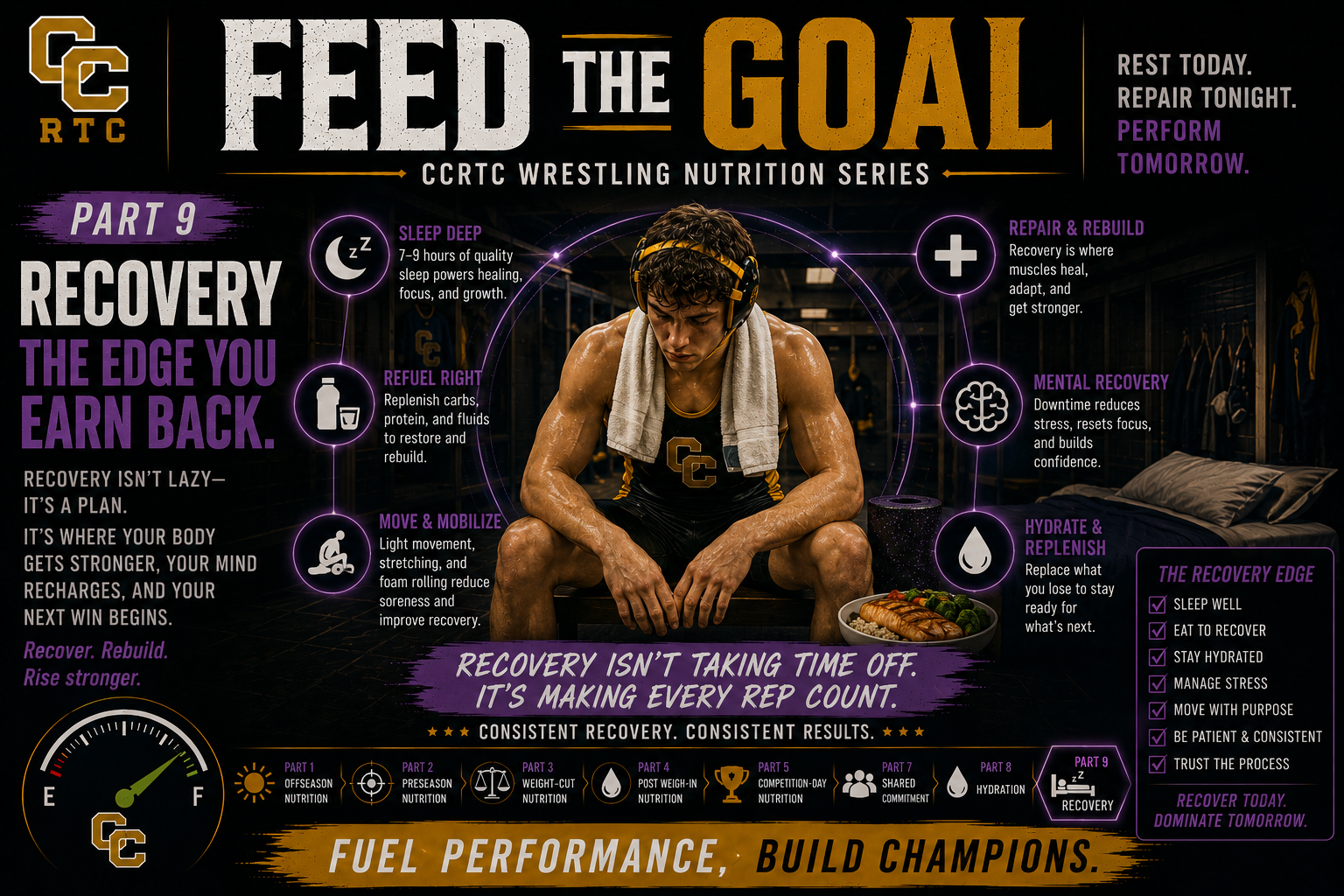
Feed the Goal – Part 9: Recovery
Why Growth Happens Between Practices
Throughout the Feed the Goal series, we have discussed how wrestlers should eat, hydrate, and support one another through the demands of training and competition. From building strength in the offseason to managing weight, recovering after weigh-ins, and understanding supplements, one theme has emerged repeatedly:
The body responds to stress only when it is given an opportunity to recover.
Recovery is often misunderstood because it does not feel productive. Wrestlers are naturally drawn to things they can see and measure—more practices, more lifting, more conditioning, more matches. Parents and coaches often celebrate hard work and sacrifice, and rightfully so. Wrestling is not a sport for the lazy.
But there is a truth that many athletes discover only after years of frustration:
Growth does not happen during practice.
Growth happens afterward.
Recovery is not something separate from training.
Recovery is training.
Sleep: The Ultimate Performance Enhancer
No supplement, recovery gadget, or fancy program can replace sleep.
Sleep is where much of the body’s work actually takes place. During deep sleep, growth hormone is released, muscles repair themselves, memories are consolidated, and the brain recovers from the demands of both school and sport. For teenagers, this becomes even more important because they are not only training, but growing.
Lack of sleep affects:
- Strength and power production.
- Reaction time and decision-making.
- Mood and emotional regulation.
- Learning and memory.
- Academic performance.
- Hormonal health.
- Injury risk.
Perhaps most importantly, sleep debt accumulates. One poor night of sleep may not be noticeable, but several nights in a row can dramatically affect performance.
You cannot outwork poor sleep.
Muscle Growth Happens During Recovery
As discussed in Part 1, strength training creates stress and microscopic damage within muscle tissue. That stress is necessary, but it is only half of the equation.
The body becomes stronger during recovery.
Without proper sleep, hydration, and nutrition, the body struggles to adapt. Athletes often respond to plateaus by working harder, when the answer may actually be recovering better.
Practice creates fatigue.
Recovery creates athletes.
Recovery Nutrition Matters
Recovery begins long before the body touches a pillow.
Throughout Parts 1 through 8, we have discussed how proper nutrition and hydration support performance. Those same habits support recovery.
Recovery requires:
- Sufficient protein for muscle repair.
- Carbohydrates to replenish glycogen stores.
- Fluids and electrolytes to restore hydration.
- Healthy fats to support hormonal health.
- Consistent eating habits.
As discussed in Part 7, hydration itself is performance. Likewise, Part 8 reminded us that supplements are merely tools. No supplement can compensate for poor recovery habits.
Stress Is Stress
Teenagers often carry far more stress than adults realize.
Wrestling is only one piece of the puzzle.
Stress comes from many sources:
- School and academics.
- Relationships.
- Social media.
- Family pressures.
- Competition.
- Travel.
- Expectations.
The body does not distinguish between these forms of stress. It simply responds to the total amount being placed upon it.
Without recovery, stress accumulates and eventually leads to burnout.
Recovery Requires Courage
In today’s culture, hard work is often glorified while recovery is misunderstood.
Teenagers constantly hear messages like:
- “No days off.”
- “Sleep when you’re dead.”
- “Everybody else is working.”
- “Grind harder.”
Social media amplifies these messages. Friends may pressure athletes to stay up late. Teammates may encourage extra workouts. Parents may unintentionally over-schedule. Coaches can sometimes celebrate exhaustion rather than adaptation.
But recovery requires a different kind of bravery.
Sometimes the most disciplined decision is saying no.
Not because you lack toughness.
Because you understand that consistency beats occasional heroics.
Recovery teaches delayed gratification.
The rewards come slowly:
- Better mood.
- Greater strength.
- Improved concentration.
- Better grades.
- Fewer injuries.
- More consistent performances.
Not everything worthwhile happens immediately.
Active Recovery Has Value
Recovery does not always mean sitting still.
Movement itself can aid recovery.
Examples include:
- Walking.
- Stretching.
- Mobility work.
- Swimming.
- Easy bike rides.
- Light drilling.
The goal is not to create more fatigue.
The goal is to help the body recover from it.
Rest Days Are Not Weakness
One of the most difficult lessons for competitive athletes to learn is that rest is not the enemy.
Many wrestlers fear that taking a day off means someone else is getting ahead.
In reality, overtrained athletes rarely outperform well-recovered athletes.
The purpose of rest is not to avoid work.
It is to prepare for more work.
Injury Recovery Is Different From Laziness
Throughout this series, we have repeatedly encouraged wrestlers to embrace discomfort and avoid making excuses. Wrestling requires toughness, and soreness, fatigue, and adversity are all part of growth.
But injury and pain are not the same thing.
Recovery should never become an excuse for laziness.
Likewise, toughness should never become an excuse for ignoring injuries.
Athletes are expected to:
- Push through discomfort.
- Embrace soreness.
- Work through adversity.
But injuries are different.
Bravery sometimes means asking for help.
Bravery sometimes means doing rehabilitation.
Bravery sometimes means being patient.
Missing two weeks is better than missing two seasons.
Recovery assumes that hard work has already taken place.
Recovery is preparation—not avoidance.
Phones May Be Stealing Performance
Many teenagers unknowingly sabotage their own recovery through late-night habits.
The constant pull of:
- Social media.
- Gaming.
- Notifications.
- Endless scrolling.
Creates an environment that robs athletes of quality sleep.
Parents have tremendous influence here.
A family charging station outside the bedroom may do more for performance than any supplement ever purchased.
Signs of Poor Recovery
The body whispers before it screams.
Common warning signs include:
- Constant fatigue.
- Irritability.
- Frequent illness.
- Trouble concentrating.
- Decreased strength.
- Loss of motivation.
- Poor sleep.
- Loss of appetite.
- Increased injuries.
These signals should not be ignored.
Parents Create Recovery Culture
As discussed in Part 6, support systems matter.
Home should be a place of peace and restoration—not another source of pressure.
Parents model recovery every day.
Children observe:
- Whether parents prioritize sleep.
- Whether family meals exist.
- Whether phones dominate evenings.
- Whether life constantly feels rushed.
A calm home becomes a competitive advantage.
Recovery culture matters.
Coaches Must Teach Recovery
Great coaches do more than push athletes.
They teach stewardship.
The goal is not exhausted wrestlers.
The goal is resilient wrestlers.
Sometimes athletes need protection from themselves.
Managing workloads is wisdom.
Not weakness.
Emotional and Spiritual Recovery Matter Too
Recovery is not merely physical.
Athletes need time to:
- Laugh.
- Spend time with family.
- Enjoy friendships.
- Reflect.
- Pray.
- Simply be kids.
Not every waking moment needs to be productive.
Balance is healthy.
Perspective matters.
Common Recovery Myths
Myth: More work is always better.
Better work is better.
Myth: Sleep is optional.
Sleep is mandatory.
Myth: Rest means weakness.
Rest is preparation.
Myth: Recovery is laziness.
Recovery assumes effort.
Myth: I’ll recover after the season.
Recovery delayed is performance denied.
Looking Ahead
Recovery is often overlooked because it doesn’t feel exciting. Yet it may be the greatest competitive advantage available to wrestlers.
In Part 10, we’ll discuss how travel, camps, and tournaments create unique nutritional challenges and how athletes can maintain healthy habits away from home.
Because discipline should travel with you.
Feed the Goal
Anyone can work hard.
Very few recover well.
Great wrestlers understand both.
Recovery is not the reward for training.
Recovery is part of the training.
Protect your sleep.
Honor your body.
Respect the process.
Because growth happens between practices.
Feed the goal.


One Comment