Feed the Goal – Part 6: Shared Commitment
Why Families and Friends Matter More Than You Think
Throughout the Feed the Goal series, we’ve focused primarily on what wrestlers should eat during the different phases of the year. We’ve discussed building strength in the offseason, preparing for the season ahead, making weight safely, recovering after weigh-ins, and fueling performance during competition.
But there is another aspect of nutrition that often goes overlooked.
Wrestling may be an individual sport, but very few wrestlers reach their goals through individual effort alone.
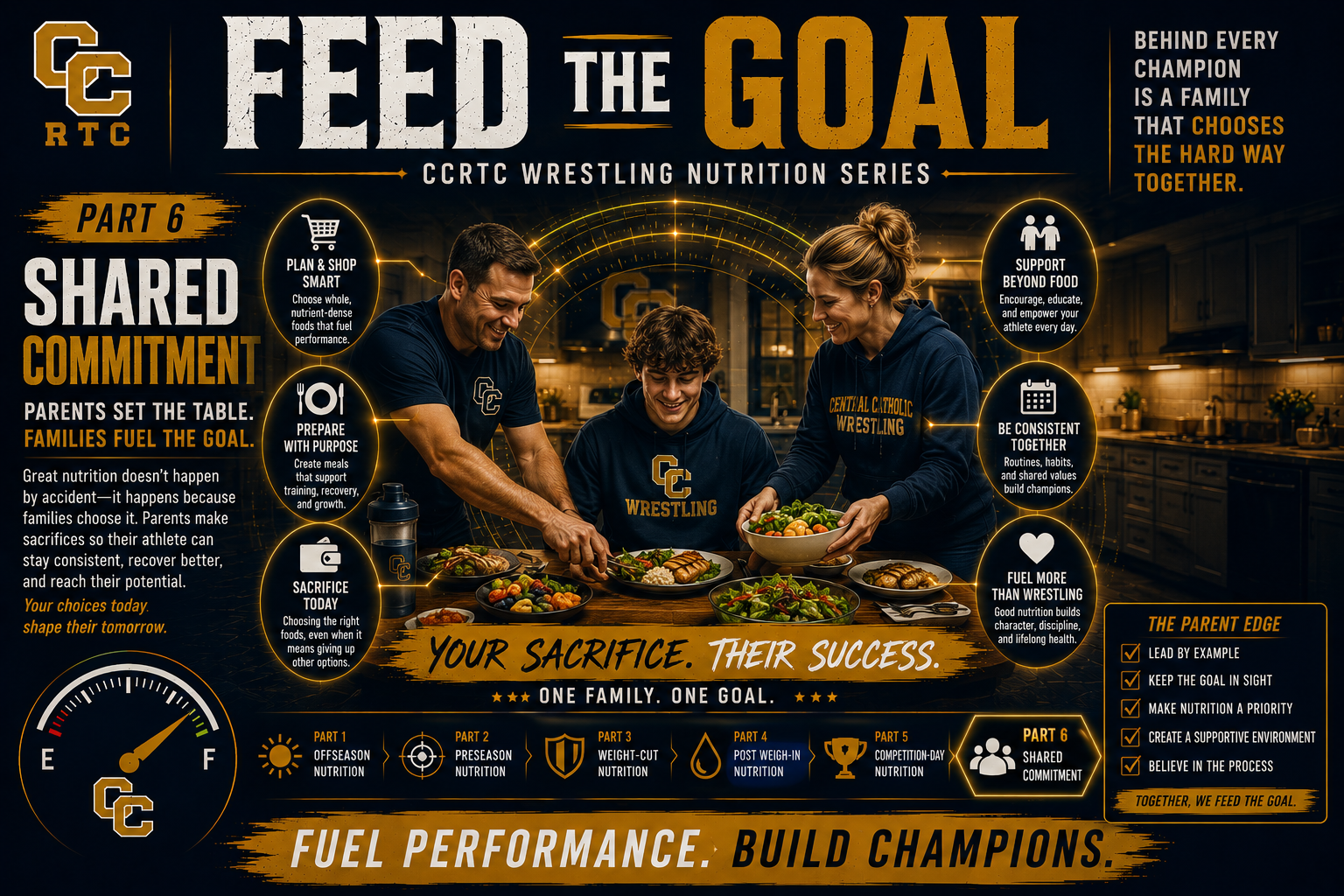
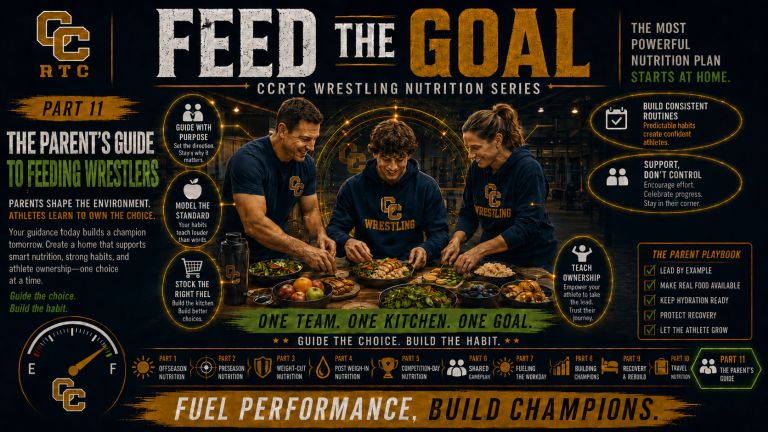
Behind every successful athlete are parents who drove to practices, siblings who tolerated changed schedules, teammates who shared difficult workouts, and friends who provided encouragement. Nutrition is no different. While the athlete may be the one stepping on the scale and walking onto the mat, the journey itself is often shared.
The best support systems don’t simply cheer from the sidelines.
They participate.
Success Is Easier When It Is Shared
Parents frequently ask what they can do to support their athlete. Often, they assume the answer involves more travel, more camps, or more expensive opportunities. While those things may have value, some of the most important forms of support are far simpler.
Sometimes, the greatest gift a parent can give is refusing to make the athlete walk the journey alone.
When an athlete is eliminating soda, it helps when the family eliminates soda. When a wrestler is emphasizing lean proteins and healthy carbohydrates, it helps when those foods become the staples of family meals. When body composition becomes important, it helps when the home environment reflects those goals rather than constantly working against them.
Support is not always found in words.
Often, support is found in shared experiences.
After all, few things are more difficult than asking a young athlete to exercise discipline while everyone around them is moving in a different direction.
Environment Matters More Than Willpower
Parents sometimes unknowingly create unnecessary battles. They ask their wrestler to avoid junk food while the pantry remains full of cookies and chips. They encourage healthy eating while bringing home fast food several nights a week. They ask for discipline while surrounding the athlete with temptation.
Nobody does this intentionally.
Yet success becomes much easier when the environment supports the goal.
At our house, we jokingly refer to certain foods as “contraband.” The term is tongue-in-cheek, but the principle behind it is serious. If there are foods that don’t support the athlete’s goals, we simply don’t keep them in the house.
That doesn’t mean family members never enjoy them.
Quite the opposite.
As parents, we may occasionally choose to indulge in foods that don’t fit our athlete’s nutritional needs. We simply do so when our sons are not around. If we’re going to have dessert, enjoy a soda, or eat something that doesn’t align with their goals, we prefer to do it away from the sights, smells, and temptations that can make discipline more difficult.
Supporting the athlete’s goals becomes more important than satisfying a craving in front of them.
It’s a small sacrifice, but those small sacrifices add up.
Shared Sacrifice Creates Shared Success
One of the unexpected benefits of supporting a wrestler’s nutritional goals is that the entire family often benefits as well.
Meals become more intentional. Soft drinks disappear. Healthier habits become normal. Family members start feeling better, sleeping better, and discovering that many of the changes they made for the athlete improve their own lives too.
This is rarely the original goal.
But positive habits have a way of spreading.
Over time, families often find themselves improving alongside the athlete—not because they had to, but because they chose to.
Shared sacrifice creates shared success.
Parents Set The Tone
Children are always watching.
Parents sometimes underestimate how closely young athletes observe their behavior. A parent who constantly says, “You shouldn’t eat that,” while eating it themselves sends a confusing message. Likewise, asking for discipline while refusing to practice discipline diminishes the power of the lesson.
Young athletes learn far more from what parents do than what they say.
Perhaps the most powerful message a parent can communicate is simple:
“We are in this together.”
Not because everyone needs to make weight.
Not because everyone needs to wrestle.
But because families support one another.
Those words carry weight.
Friends Matter Too
Eventually, athletes spend more time away from home than they do inside it. School friends, teammates, and social circles begin to exert tremendous influence over daily decisions.
For that reason, athletes should communicate their goals.
Most friends don’t intentionally sabotage progress. More often, they simply don’t know. If your friends understand your goals, many will naturally become allies. Some may choose to eat similarly. Others may simply avoid placing unnecessary temptations in front of you.
Good friends want to help.
Sometimes they just need to know how.
Over time, some may even adopt healthier habits themselves.
Culture Matters
One of the reasons wrestling communities are so powerful is because athletes don’t pursue goals in isolation.
They train together.
They travel together.
They share meals.
They encourage one another.
Success becomes contagious.
Discipline becomes normal.
Healthy habits become expected.
Culture matters.
And culture begins when people choose to support one another.
The Goal Is Bigger Than Food
Ultimately, this article isn’t really about nutrition.
It’s about relationships.
It’s about sacrifice.
It’s about deciding that someone else’s goals matter enough that you’re willing to walk beside them.
No wrestler succeeds alone. Behind every successful athlete are parents who made sacrifices, siblings who showed patience, teammates who shared the journey, and friends who offered support.
Wrestling may be an individual sport.
But greatness is rarely an individual accomplishment.
Feed the Goal
The best support systems don’t simply watch.
They participate.
They encourage.
They sacrifice.
They understand.
They share the experience.
Because the strongest athletes are often surrounded by people who have chosen to say:
“We’re in this together.”
And sometimes, that support starts with something as simple as keeping the contraband out of the pantry.
Feed the goal.
And help others feed it too.

7 Comments