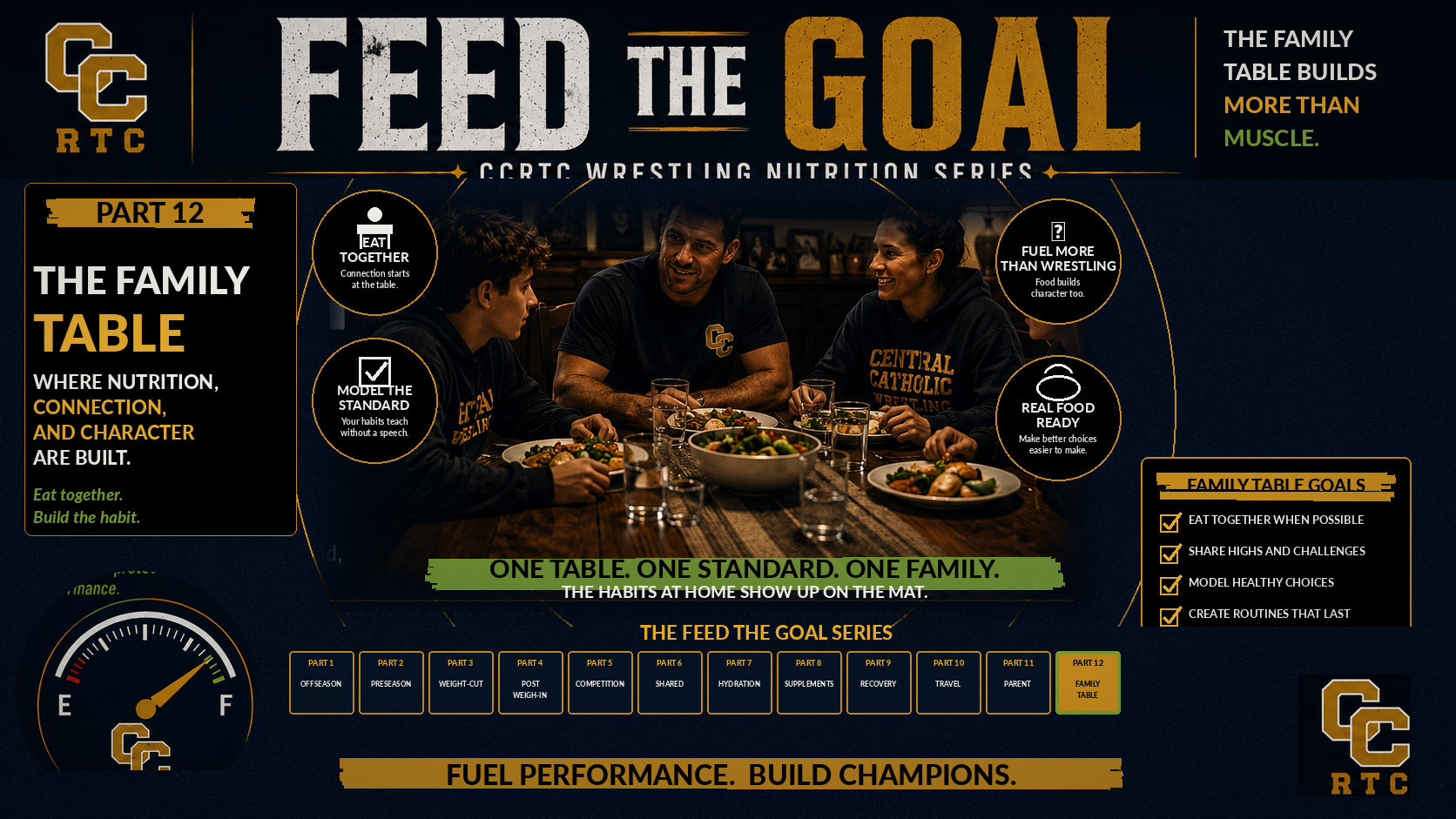
Feed the Goal – Part 12: The Family Table
Why Eating Together Still Matters
Throughout this series, we’ve explored what wrestlers should eat, when they should eat, how to recover, travel, hydrate, and prepare for competition. We’ve also discussed the important role parents play in supporting young athletes. Yet all of those lessons ultimately converge in one place that often receives far less attention than it deserves:
The family table.
Long before a wrestler steps onto the mat, they spend years watching the people around them. They observe eating habits, attitudes toward food, conversations during meals, and the priorities demonstrated by the family. Those seemingly ordinary moments become the foundation upon which healthy habits are built.
The family table is not simply where meals are served.
It is where culture is created.
The Goal Is Never to Feed Only the Wrestler
One of the most common mistakes families make is preparing one meal for the wrestler and another for everyone else. While there are certainly times when an athlete’s nutritional needs require small adjustments, most healthy eating habits benefit the entire household.
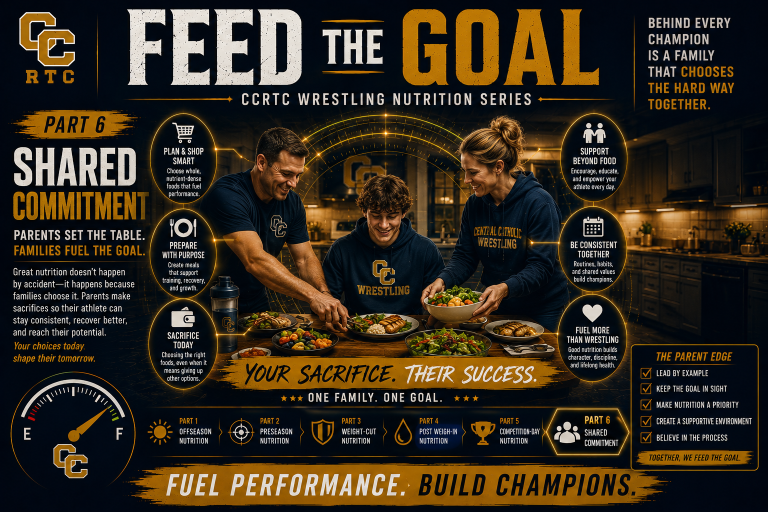
As discussed in Part 6: Shared Commitment, the athlete should never feel as though they are walking this journey alone. Families who choose to participate in healthy eating together often discover unexpected benefits for themselves.
Shared meals naturally encourage:
- Better food choices.
- More consistent meal schedules.
- Fewer processed foods.
- Increased fruit and vegetable consumption.
- Better hydration habits.
- More meaningful conversations.
The goal is not to place the entire family on a wrestler’s meal plan.
The goal is to build a household where healthy choices become normal.
Children Learn More From What They See Than What They Hear
Parents often spend considerable time telling children how they should eat.
Far more influential, however, is what children observe every day.
If parents prioritize balanced meals, drink water regularly, sit down together for dinner, and make thoughtful food choices, those habits become part of the family’s identity. Conversely, if healthy eating is expected only of the athlete while everyone else follows a different standard, the message becomes much harder to accept.
As discussed in Part 11, stewardship is taught through example.
Children rarely become what they are told.
They often become what they repeatedly see.
Shared Commitment Builds Stronger Families
Earlier in the series we introduced the idea of shared commitment. Families do not need to train like wrestlers to support one.
They simply need to participate.
Sometimes that means choosing grilled chicken instead of fried food.
Sometimes it means serving water instead of soda.
Sometimes it means preparing meals that support the athlete’s goals rather than creating unnecessary temptation.
These decisions are rarely about sacrifice.
They are about support.
In our own family, we jokingly refer to foods that don’t fit our athlete’s current goals as “contraband.” The name is lighthearted, but the principle behind it is meaningful.
If we choose to enjoy foods that don’t support the athlete’s nutritional needs, we often do so when they are not around. Not because those foods are forbidden, but because removing unnecessary temptation is one small way we can help support someone else’s goals.
Support is often demonstrated through small, consistent decisions.
Meals Are About More Than Nutrition
Family dinners provide something that cannot be measured in calories or grams of protein.
They provide connection.
Some of the most important conversations between parents and children occur around the dinner table. Victories are celebrated. Losses are processed. Goals are discussed. Gratitude is practiced. Problems are solved.
The meal itself becomes only one part of the experience.
The relationships built around it become equally valuable.
When possible, protect those opportunities.
Turn off the television.
Set the phones aside.
Be fully present.
The investment made during those conversations often extends far beyond wrestling.
The Family Benefits Too
Healthy eating is sometimes viewed as something parents do only for the athlete.
In reality, everyone benefits.
Families often notice:
- Improved energy.
- Better sleep.
- More consistent eating habits.
- Better overall health.
- Greater awareness of nutrition.
Even those who are not training every day frequently discover that the same habits supporting the wrestler also improve their own quality of life.
Supporting an athlete often becomes an opportunity for the entire family to become healthier together.
The Table Is Also a Classroom
The dinner table provides countless opportunities to prepare young athletes for adulthood.
Parents can gradually involve children in:
- Planning meals.
- Reading nutrition labels.
- Grocery shopping.
- Preparing food.
- Understanding portion sizes.
- Cleaning up afterward.
As discussed in Part 11, the ultimate goal is independence.
Eventually, every wrestler will prepare meals without mom or dad standing beside them.
The family table becomes the place where those lifelong skills begin.
Healthy Eating Should Never Eliminate Joy
One of the greatest misconceptions surrounding sports nutrition is that healthy eating requires perfection.
It does not.
Families should continue celebrating birthdays.
Holidays should remain holidays.
Traditions should continue.
Ice cream after a successful season, a family barbecue during the offseason, or dessert on a special occasion are not failures of discipline.
They are part of a balanced life.
The difference is intentionality.
Healthy habits should define the family.
Celebrations should remain celebrations.
As discussed throughout this series, context matters.
Gratitude Belongs at the Table
The family table also reminds us that every meal represents the efforts of someone else.
Parents worked to provide it.
Someone planned it.
Someone prepared it.
Someone cleaned up afterward.
Teaching gratitude for those unseen efforts builds appreciation that extends far beyond nutrition.
Wrestling teaches athletes to respect hard work.
The family table teaches them to recognize it.
Looking Ahead
Healthy eating begins at home, but eventually every athlete leaves home.
Whether traveling to tournaments, moving into a college dorm, or beginning life independently, wrestlers will eventually make every nutritional decision for themselves.
The habits practiced around today’s family table become tomorrow’s lifelong routines.
In the next chapter, we’ll explore some of the most common nutritional mistakes wrestlers, parents, and coaches make—and how avoiding a handful of small errors can produce significant improvements in performance.
Because championships are rarely lost because of one big mistake.
More often, they are lost through a collection of small ones.
Feed the Goal
The family table is about far more than food.
It is where discipline is modeled.
Where encouragement is shared.
Where gratitude is practiced.
Where relationships are strengthened.
Where healthy habits quietly become lifelong habits.
The strongest wrestling families understand that success is rarely built by one person alone.
It is built meal by meal.
Conversation by conversation.
Choice by choice.
Feed the goal.
And let the family table become one of the places where that goal is nourished every day.