
A Missed Opportunity?
What the Cortez–Magomedov Final Reveals About Scoring, Challenges, and Early Match Decisions
The 57 kg U20 World Championship final between Isaiah Cortez of the United States and Magomed Magomedov produced an early exchange that deserves closer examination—not because it proves the wrong wrestler won, but because it illustrates how quickly an international wrestling match can be shaped by interpretation, communication and uncertainty.
Magomedov ultimately won the bout 8–4 and was rightfully recognized as the world champion under the scoring decisions made on the mat.
That result should be respected.
At the same time, the opening scramble raises a legitimate question: was Isaiah Cortez fully credited for the action he created, and did everyone involved have enough time and information to recognize what may have happened?
The answer is not obvious.
That is precisely what makes the sequence worth studying.
The Exchange That Changed the Match State
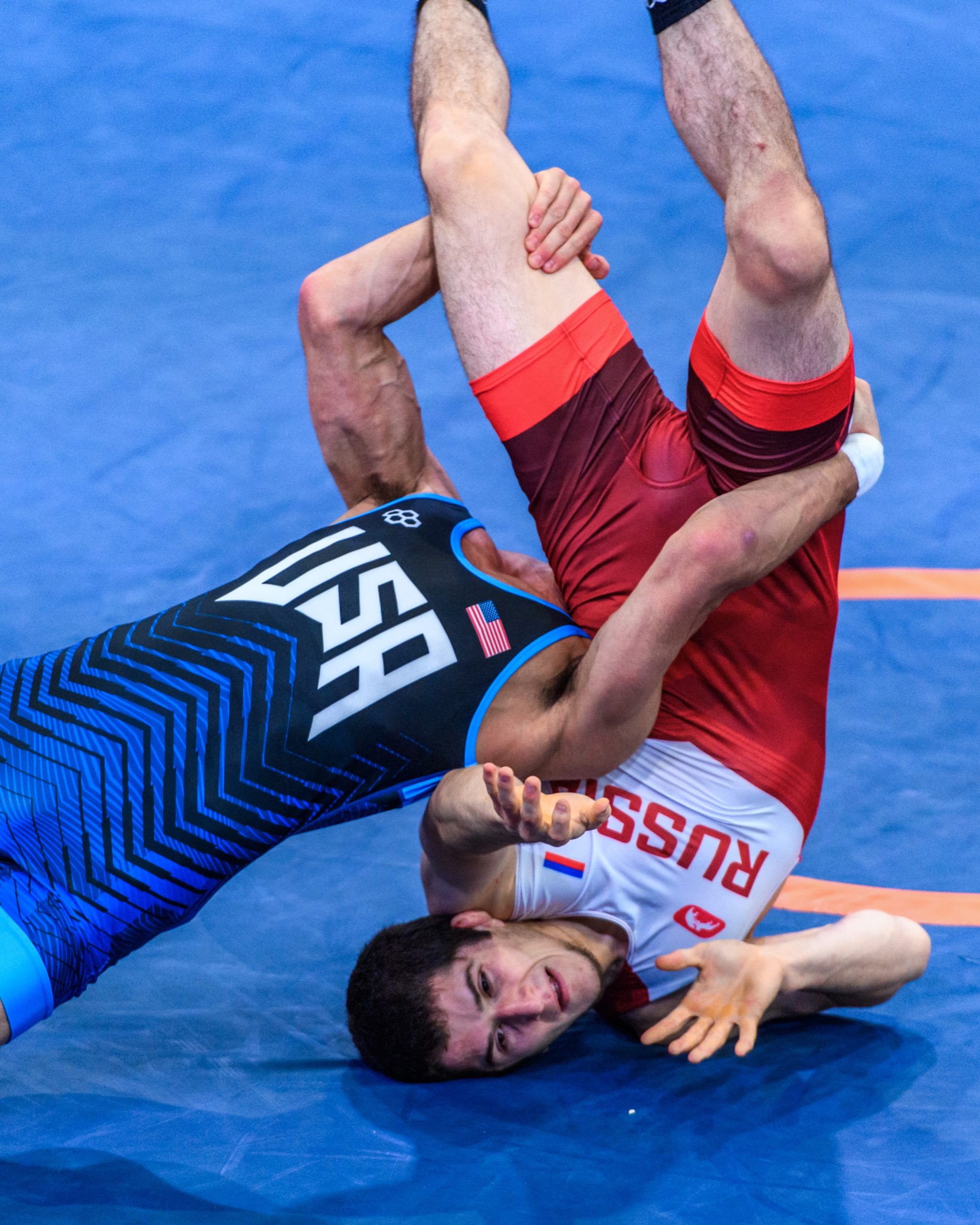
Cortez entered the major scramble already leading 1–0 after Magomedov failed to score during an activity period.
Cortez then attacked aggressively, penetrating on the leg and driving the action into a rotational scramble. During the sequence, both wrestlers passed through positions capable of producing freestyle scoring.
When the action finished, the scoring went two points to Magomedov and one to Cortez.
The result was a 2–2 tie, with Magomedov holding the advantage on criteria.
UWW’s own account confirms that 2–2 score before Magomedov later added another takedown and entered the break ahead 4–2.
The controversy begins with a simple observation:
Cortez appears to be the wrestler who initiated and drove the sequence.
That alone does not mean he deserved the scoring value. A defender can absolutely score from an opponent’s attack.
But under UWW rules, determining who receives the points requires more than identifying who eventually comes out on top.
It requires determining who actually created the scoring action.
What Did the Officials Actually See?
Fast freestyle scrambles can look dramatically different depending on the angle from which they are viewed.
The referee is moving around the wrestlers while attempting to see shoulders, hips, control and the direction of action simultaneously.
The judge views the action from another location.
The mat chairman has yet another angle.
Those perspectives are valuable because wrestling uses a three-person officiating system precisely to reduce the effect of one person’s obstructed view.
But different angles can also produce different interpretations.
One official may see the defensive wrestler apparently directing the attacker toward his back.
Another may see the attacker’s original momentum producing the entire rotation.
A shoulder, arm or hip can momentarily block the referee’s line of sight at exactly the instant when the scoring distinction is created.
That possibility matters in the Cortez–Magomedov exchange because the decisive question may have occurred within less than a second.
Was Cortez moving through his own bridge as part of his offensive action?
Or had Magomedov interrupted that attack, redirected Cortez and taken control of the sequence?
Those are very different things under freestyle rules.
Yet in real time, they can look remarkably similar.
Offensive Risk Does Not Automatically Become Defensive Scoring
Article 34 of the UWW rulebook is particularly important here because it protects offensive risk.
When an attacking wrestler executes a hold and passes through his own danger position, his back touching or approaching the mat does not automatically create points for the defender.
An attacker can move through his own bridge while continuing to complete the offensive action.
For the defending wrestler to take over the scoring value, something more must generally occur: the defender must meaningfully counter, redirect, block or control the attacker in the danger position.
That distinction creates the strongest technical argument for Cortez.
The issue is not simply that Cortez attacked first.
The issue is whether Magomedov performed enough independent action to become the wrestler responsible for Cortez’s exposure.
If he did, the official two-point award is defensible.
If he did not—if Cortez’s own attack produced the rotation, exposed Magomedov and carried Cortez briefly through his own shoulders before he continued through the position—then there is a reasonable argument that the initial scoring value belonged to Cortez.
That is not a minor distinction.
It is the difference between rewarding a successful counter and accidentally converting an offensive wrestler’s risk action into points for his opponent.
Why the 2–1 Score Matters
The scoring itself tells us how the officiating team interpreted the exchange.
Magomedov received two points.
Cortez received one.
That suggests the officials viewed Magomedov as controlling the principal scoring action and Cortez as subsequently reversing the position.
Under that interpretation, the scoring makes sense.
The sequence becomes:
Magomedov scores the exposure. Cortez then works through and reverses.
But that interpretation depends on the first proposition being correct.
Did Magomedov actually own the initial exposure?
That is where reasonable disagreement begins.
If Cortez’s original attack remained one continuous action and Magomedov was being carried through danger rather than actively creating the counter, the whole scoring structure can change.
Under an alternate interpretation, Cortez may have deserved the principal two-point value, with the remainder of the scramble evaluated from there.
That could have left Cortez with a meaningful early lead rather than a 2–2 score in which Magomedov held criteria.
And that is where an officiating interpretation becomes a match-management issue.
Could the Referee and Table Have Seen Different Actions?
This possibility should not be treated as an accusation.
It is an inherent feature of wrestling officiating.
The referee, judge and chairman are not viewing a synchronized television replay when the action first occurs. They are making real-time judgments from different physical positions.
Sometimes one official has the best angle.
Sometimes another does.
Sometimes the official who sees the decisive detail clearly is not the official whose scoring interpretation ultimately prevails.
The three-person system is designed to resolve disagreement, but it cannot completely eliminate uncertainty.
A complicated roll-through is particularly vulnerable to this problem because the scoring may depend upon a very short moment of control or redirection.
If the referee saw Cortez driving Magomedov through exposure while the judge saw Magomedov catching Cortez across his back, each might be responding honestly to a different visual impression of the same action.
The resulting score can therefore be technically consistent while still being based on an incomplete picture.
That possibility is one reason the challenge system exists.
The Challenge Problem
From the outside, throwing the challenge block can seem easy.
If a spectator believes the call is wrong, the natural reaction is:
Why didn’t the coaches challenge it?
The reality is more difficult.
A coach has only a short window to process several pieces of information.
First, the coach must know exactly what the officials awarded.
Then the coach must understand why they awarded it.
Then the coach must decide whether the available video is likely to show something different.
Then the coach must calculate the risk of losing the challenge.
All of that occurs while the wrestler is preparing to restart and the match continues moving forward.
There is rarely certainty.
Why Coaches Can Miss the Moment
It is entirely possible that a coaching staff recognizes that a scramble was unusual but does not immediately recognize how the officials scored it.
The coach may have seen Cortez initiate the action and assumed the two-point signal corresponded to Cortez.
Another official may have signaled something from an angle that was difficult to see from the corner.
The scoreboard may update only after the coach’s attention has already shifted back toward the athletes.
By the time the discrepancy becomes clear, the practical challenge window may be disappearing.
This does not mean that happened in this final.
Without hearing from the U.S. corner, it would be unfair to state that it did.
But it is one plausible explanation among several.
And that distinction matters.
Post-match viewers can replay the sequence repeatedly and analyze each scoring gesture.
A coach may have only seconds to determine that the scoreboard reflects something different from what he believed he had just watched.
Or the Coaches May Have Seen It—and Chosen Not to Challenge
There is another equally reasonable possibility.
The American corner may have understood exactly what had been awarded and still decided against challenging.
A failed challenge carries consequences.
If the original call is upheld, the opponent receives an additional point and the challenger loses the ability to challenge again later in the bout.
Early in a World Championship final, that is a meaningful risk.
A coach may therefore look at a difficult scramble and think:
I disagree with the call, but I am not certain the replay will overturn it.
That is not the same thing as believing the call was correct.
It is a judgment about probability.
And this is where challenge strategy becomes particularly interesting.
How Certain Does a Coach Need to Be?
A challenge should not require absolute certainty.
If certainty were required, many legitimate challenges would never be made.
The better question is whether the potential value of correcting the call is large enough to justify the risk of being wrong.
In this case, the potential correction was significant.
This was not necessarily a dispute over a single step-out point.
It involved the principal two-point action in a scramble.
If the initial exposure belonged to Cortez rather than Magomedov, the practical change to the match could have involved several elements at once:
- Cortez’s total score.
- Magomedov’s total score.
- Criteria.
- Who was leading.
- Which wrestler had to attack next.
That makes the exchange unusually important from a challenge-management standpoint.
Saving the brick for later has value.
But so does correcting the most consequential scoring error available.
Sometimes the best challenge opportunity occurs in the first minute rather than the last.
The Problem With Waiting for a “Better” Challenge
There is a common coaching instinct to preserve the challenge for late in the bout.
That can be wise.
It can also become overly conservative.
A challenge block sitting in the corner at the end of the match has no value if the most important questionable call occurred four minutes earlier.
The proper decision therefore cannot be based simply on time remaining.
The coach must estimate three things:
How likely is the call to be changed?
How many points or criteria positions could change?
How damaging is the penalty if the challenge fails?
An early two-point scoring dispute can sometimes carry greater expected value than a late one-point dispute.
The difficulty is that the coach must make that calculation almost instantly.
This Is Where a Possible Missed Opportunity Emerges
None of these possibilities can be established with certainty from outside the corner.
Perhaps the officials correctly recognized a Magomedov counter that is difficult for spectators to appreciate.
Perhaps the referee had one interpretation while the judge and chairman saw another.
Perhaps the American coaches agreed with the official scoring.
Perhaps they disagreed but believed the video would not be sufficient to overturn it.
Perhaps they initially believed Cortez had received the two points and did not recognize the discrepancy quickly enough.
Or perhaps they recognized everything correctly and simply decided the risk was not worth taking so early.
Every one of those explanations is plausible.
But taken together, they create a broader conclusion:
There were multiple points in the process at which Cortez may not have received the full benefit of another careful look.
That does not necessarily mean anyone failed in an obvious way.
It may have been an accumulation of small uncertainties.
An official sees one part of the action.
Another sees another.
The scoring is entered.
The corner needs a moment to understand the decision.
The athletes return to the center.
The coach weighs the risk.
The opportunity passes.
Nothing individually has to be outrageous for the combined result to matter.
The Importance of Match Trajectory
Magomedov ultimately won 8–4.
That fact makes it tempting to conclude that the opening exchange was not decisive.
But wrestling matches are not static scoring exercises.
The scoreboard affects behavior.
A wrestler who is leading can manage space and time differently.
A wrestler who is trailing must eventually create more offense.
That increased urgency can lead to more attacks—but also more counterattacks and more opportunities for the opponent.
Had Cortez emerged from the early exchange with a clear lead, Magomedov might have been forced to wrestle differently.
Cortez might have been able to choose his attacks differently.
Both wrestlers might have approached the edge differently.
Magomedov might still have won.
Cortez might have extended the lead.
Neither outcome can be known.
The important analytical point is that the remainder of the match cannot simply be replayed in our imagination with a different opening score while assuming every later action remains unchanged.
Different scores create different matches.
Momentum Without Mythology
The term “momentum” can sound vague, but in wrestling it has concrete components.
Momentum can mean scoring first.
It can mean discovering that an attack works.
It can mean forcing an opponent to respect a position.
It can mean having criteria.
It can mean being able to wrestle patiently while the opponent must increase risk.
Cortez attacked aggressively and created the first major scramble of the final.
Had that action produced a clear scoring advantage for him, the psychological and strategic effect could have been meaningful.
Instead, the sequence ended with Magomedov holding the advantageous interpretation of the exchange.
Shortly afterward, Magomedov extended his lead.
That does not prove one event caused the next.
It does show that Cortez’s first major offensive success did not produce the scoreboard reinforcement that it might have under another interpretation.
That is precisely the sort of early match event that can alter trajectory without single-handedly deciding the outcome.
A Fair Conclusion
The strongest case for Isaiah Cortez is not that he was unquestionably denied a World Championship.
The available evidence does not justify that claim.
Magomedov continued wrestling effectively, scored additional points and won the match under the official scoring.
The more measured conclusion is that the opening exchange contained enough technical ambiguity to deserve serious examination.
Cortez appears to have initiated and driven the action.
UWW rules specifically protect an attacking wrestler who passes through his own danger position while completing an offensive hold.
For Magomedov to receive the principal scoring value, his role had to be more than simply surviving the rotation or finishing in a favorable position. The officials had to view his action as a genuine counter that created and controlled Cortez’s danger position.
Perhaps that is exactly what happened.
But if the officials’ angles did not fully reveal the sequence, if the members of the officiating team interpreted different pieces of the scramble differently, or if the American corner did not recognize or act upon the scoring discrepancy quickly enough, then Cortez may have lost something more important than two points.
He may have lost the opportunity to have the most consequential early exchange of the match reconsidered.
That is the lesson that extends beyond Isaiah Cortez and Magomed Magomedov.
In international freestyle, an important scoring mistake does not have to be obvious.
A coach does not have to be negligent to miss the opportunity to challenge it.
And an officiating crew does not have to perform poorly for three different viewing angles to produce an imperfect interpretation of an extremely fast action.
Sometimes the difference is simply a fraction of a second, an obstructed angle, an uncertain signal or a coach who needs two seconds longer than the rules allow.
That is what makes the Cortez–Magomedov exchange such a useful case study.
The question is not whether we can prove that Cortez would have become a world champion if the sequence had been scored differently.
We cannot.
The more compelling question is whether an early sequence that may reasonably have supported a more favorable interpretation for Cortez passed through every available layer of correction—the referee, the officiating table and the coaching corner—without ever receiving the additional scrutiny it may have deserved.
If so, the missed opportunity was not necessarily a single bad call.
It was the inability of the system, in the few seconds available, to determine with enough certainty whether there was a bad call at all.
And by the time that question became easier to ask, the match had already moved on.