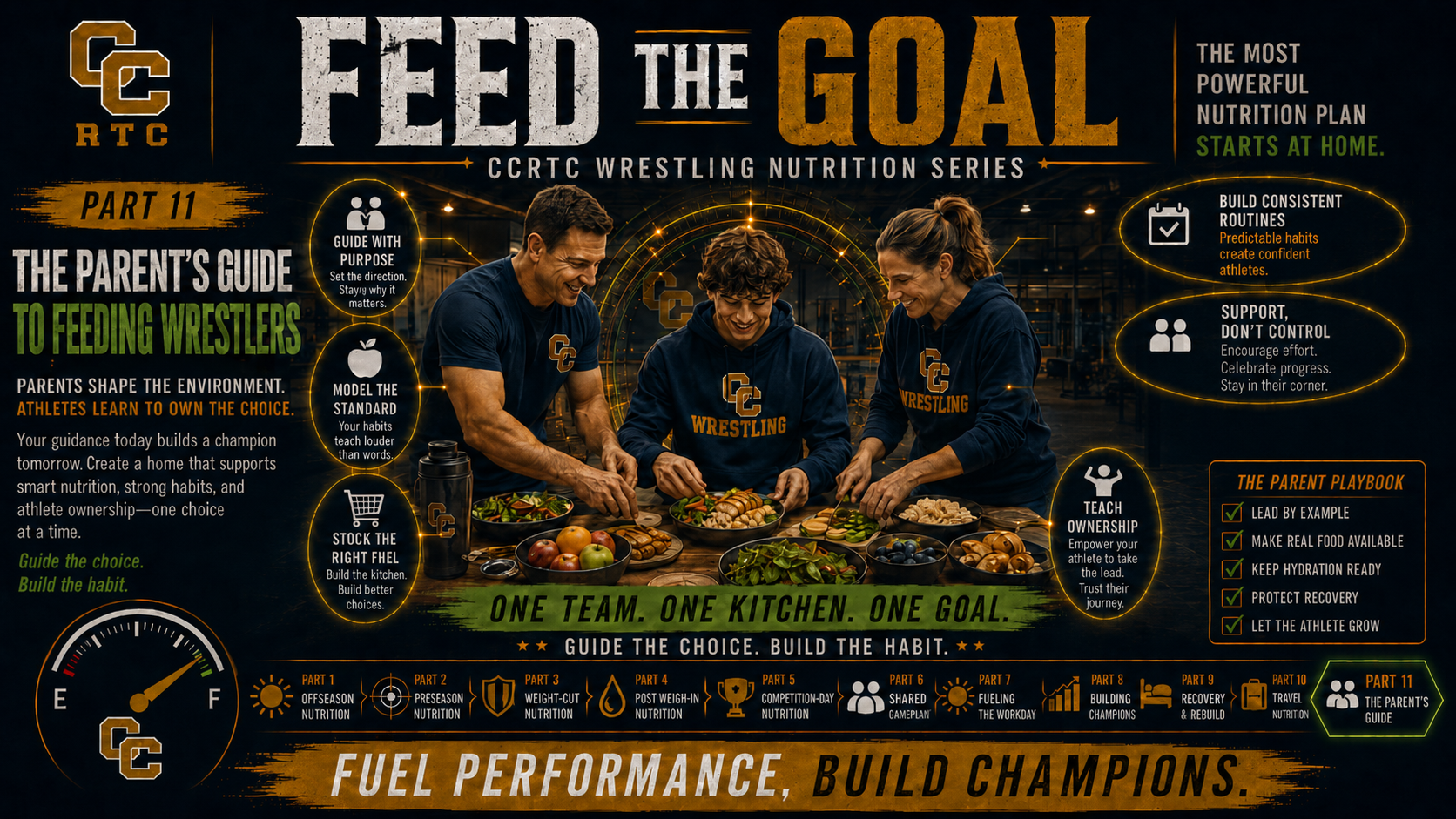
Feed the Goal – Part 11: The Parent’s Guide to Feeding Wrestlers
Supporting Performance Without Creating Anxiety
Parents play an extraordinary role in the development of young wrestlers. They provide transportation, financial support, encouragement, meals, and often become the emotional anchors that help athletes navigate both victories and disappointments. While wrestlers ultimately make decisions for themselves, parents shape much of the environment in which those decisions are made.
This article is written specifically for parents. If this is your first stop in the Feed the Goal series, welcome. While many of the topics discussed here are explored in greater depth in earlier chapters, this article is designed to stand on its own and provide a framework for helping young athletes develop healthy habits and positive relationships with food.
Most importantly, parents should understand that food should fuel performance, not fear.
Parenting Through Stewardship, Not Control
One of the greatest responsibilities parents have is teaching children how to eventually care for themselves. Wrestling provides a wonderful classroom for that process.
The goal is not to control every bite, count every calorie, or create constant anxiety surrounding food. Rather, the goal is to teach stewardship. Over time, athletes should gradually assume responsibility for their own nutrition and learn how to make wise decisions without constant supervision.
Parents are not raising wrestlers.
Parents are raising adults.
Wrestling simply provides many of the lessons.
Culture Matters More Than Rules
As discussed in Part 6: Shared Commitment, families have tremendous influence over athletes. Children absorb culture more readily than they absorb lectures.
Healthy homes often share common characteristics:
- Meals are eaten together whenever possible.
- Parents model healthy habits.
- Sleep and recovery are valued.
- Water is readily available.
- Healthy foods are normal.
- Electronics do not dominate every moment.
- Discipline is practiced without obsession.
Culture quietly shapes behavior.
Home should support the athlete rather than constantly tempt them.
Avoid Creating Fear Around Food
Parents often mean well, but wrestling can create anxiety around eating if conversations are not handled carefully.
Avoid statements like:
- “That’s bad for you.”
- “You’re getting fat.”
- “You can’t eat that.”
Instead, teach timing, balance, and context.
As discussed throughout Parts 1 through 5, foods are rarely universally good or bad. The same carbohydrate that might be inappropriate during a weight-management phase could be exactly what an athlete needs immediately after weigh-ins or during competition.
Food is fuel.
Food should not become emotional.
Food should not become punishment.
Food should not become a source of fear.
Understand the Wrestling Calendar
Many parental concerns come from not understanding that nutritional needs change throughout the year.
Part 1 discusses offseason nutrition.
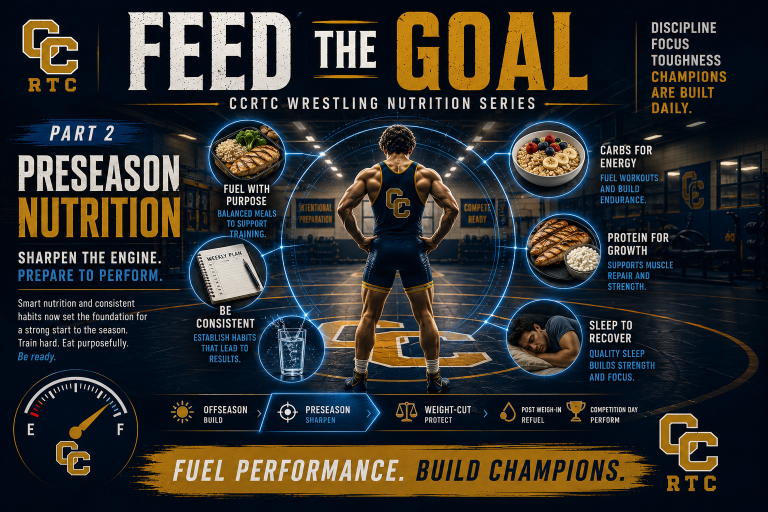
Part 2 focuses on preseason preparation.
Part 3 addresses weight management.
Part 4 explains post weigh-in recovery.
Part 5 explores competition-day fueling.
The same athlete may eat differently in July than in February.
That is normal.
Nutrition changes because demands change.
Parents Control the Kitchen
Parents do not need to become dictators.
But practically speaking, they influence many important decisions.
Parents generally control:
- Grocery shopping.
- Meal preparation.
- Restaurant choices.
- Household snacks.
- Family schedules.
- Eating routines.
As discussed in Part 6, environment matters.
Children make better decisions when healthy options are normal and readily available.
Shared Commitment Matters
Families do not need to become wrestlers.
But they should become supporters.
At our home, we jokingly refer to certain foods as “contraband.” Not because anyone is forbidden from enjoying treats, but because we understand that supporting an athlete sometimes means avoiding unnecessary temptations.
Parents do not have to eliminate every indulgence.
They simply need to ask:
“Does this help the athlete?”
If the answer is no, perhaps that treat belongs outside the home or after the season.
Shared sacrifice creates shared success.
Recovery Starts at Home
Part 9 explored how recovery itself is training.
Parents influence recovery every day through:
- Family schedules.
- Bedtimes.
- Electronics.
- Evening routines.
- Stress levels.
- Meal timing.
Home should be a refuge.
Not another source of pressure.
Children notice whether parents prioritize recovery for themselves.
Culture matters.
Recovery culture matters too.
Hydration Culture Begins With Parents
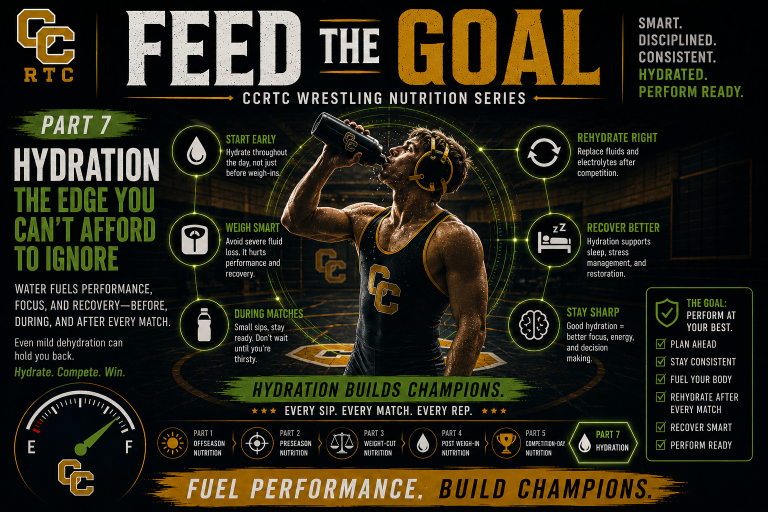
As discussed in Part 7, hydration affects everything.
Children often drink what parents drink.
Families can help by:
- Serving water with meals.
- Keeping water bottles accessible.
- Limiting soft drinks.
- Encouraging hydration throughout the day.
- Modeling good habits themselves.
Hydration is not a weight-cutting tool.
Hydration is a lifestyle.
Parents Hold the Credit Card
Part 8 discussed supplements and the importance of maintaining perspective.
Parents hold tremendous influence because they control the purse strings.
Before purchasing another supplement, ask:
- Is this solving a real problem?
- Is this replacing a habit?
- Would better food accomplish the same thing?
- Would money be better invested elsewhere?
In many cases, money spent on:
- Better food.
- Wrestling camps.
- Travel opportunities.
- Recovery.
- Sleep.
- Coaching.
Will produce far greater returns than another container of powder.
The fundamentals remain undefeated.
Let Coaches Coach
Parents should support coaches rather than compete with them.
Avoid becoming:
- Food police.
- Weight police.
- Second coaches.
- Constant critics.
Support your athlete.
Communicate concerns privately.
Trust the process.
Avoid discussing weight after every match or tournament.
Wrestling already provides enough pressure.
Home should not add to it.
Never Tie Love to Performance
This may be the most important lesson of all.
Children need to know that they are loved after victories and after losses.
They need to know they are valued after great tournaments and difficult seasons.
Performance changes.
Identity should not.
Parents should strive to ensure that wrestling becomes something children do, not who they are.
Love should never be conditional.
Avoid Using Food as Reward or Punishment
Food should never become currency.
Avoid messages like:
- “You won, so let’s binge.”
- “You lost, so no dessert.”
Meals are fuel.
Not emotional transactions.
Healthy relationships with food last far longer than wrestling careers.
Teach Ownership
Gradually transfer responsibility to the athlete.
Teach them how to:
- Fill water bottles.
- Pack snacks.
- Prepare meals.
- Read labels.
- Order wisely at restaurants.
- Make decisions independently.
Parents are preparing children for adulthood.
The responsibility should slowly become theirs.
Emotional Nutrition Matters
Meals are about more than calories.
Some of life’s greatest conversations happen around the dinner table.
Families should protect:
- Family dinners.
- Gratitude.
- Laughter.
- Conversations.
- Shared experiences.
As discussed in Part 6, culture matters.
Relationships matter.
Nutrition is about much more than food.
Avoid Comparisons
Every athlete develops differently.
Avoid comparing:
- Siblings.
- Teammates.
- Body types.
- Growth patterns.
- Success timelines.
Comparison steals joy.
Wrestling teaches patience.
Growth happens differently for everyone.
Protect Joy
Not every meal needs optimization.
Not every calorie needs to be tracked.
Not every family outing needs to become stressful.
Protect:
- Birthday cake.
- Holidays.
- Traditions.
- Ice cream.
- Celebrations.
Wrestling should enrich life.
Not consume it.
Joy and discipline are not enemies.
Travel Doesn’t Change the Mission
As discussed in Part 10, tournaments are business trips.
Parents should remember that travel is not a vacation from discipline.
Sleep, hydration, recovery, and healthy eating still matter.
Celebrate afterward.
Memories matter.
But purpose should come first.
Common Parent Mistakes
Parents sometimes unintentionally create problems by:
- Overreacting to weight changes.
- Talking excessively about food.
- Comparing athletes.
- Chasing supplements.
- Overscheduling.
- Neglecting recovery.
- Treating tournaments like vacations.
- Solving every problem for the athlete.
- Creating anxiety around meals.
- Making wrestling the center of family identity.
Fortunately, these mistakes are fixable.
Feed the Goal
Parents do not need to become nutritionists.
They do not need perfect meal plans.
They do not need to know everything.
What children need most is an environment where healthy habits are normal, discipline is supported, and love is unconditional.
Long after the medals are forgotten and the singlets are put away, the greatest gift parents provide will not be championships.
It will be the values, habits, confidence, and security that prepared their children to live well.
Because parents shape the culture that feeds the goal.
And that may be the most important contribution of all.



2 Comments