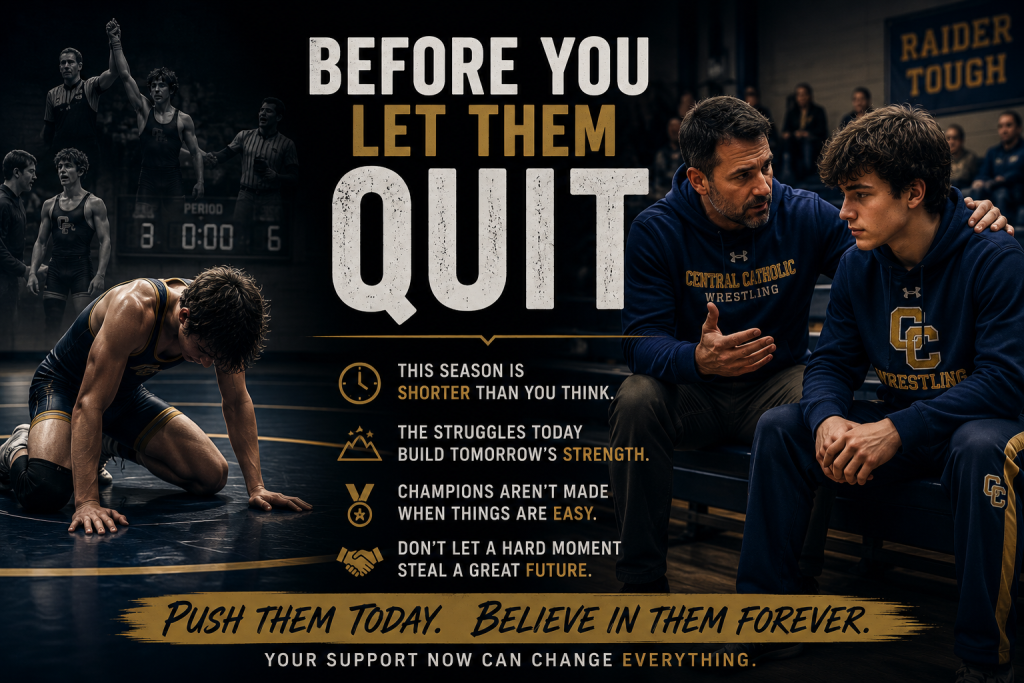
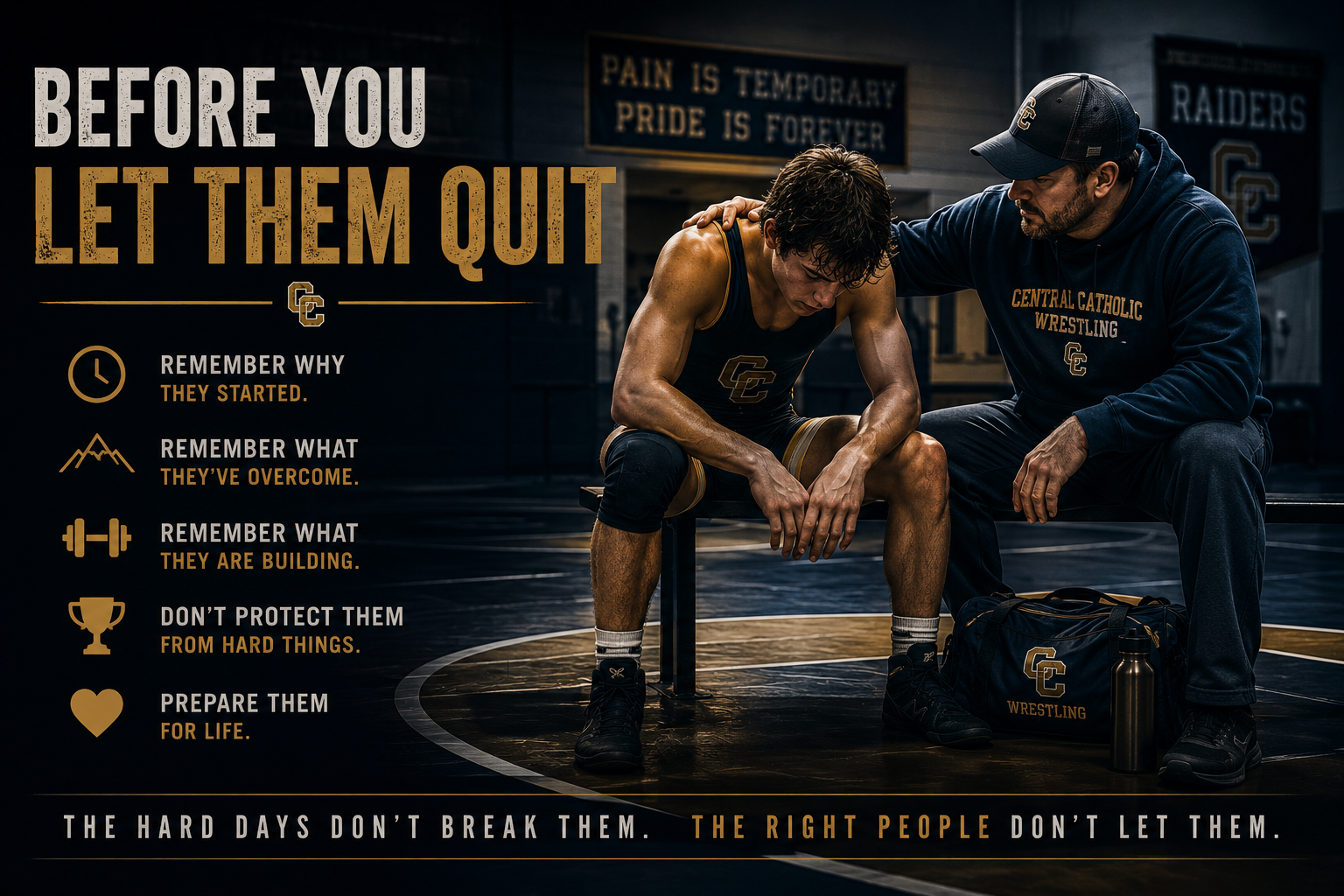
Before You Let Them Quit
Every wrestling season follows a remarkably predictable pattern.
The first few weeks are exciting. New gear arrives. Goals are discussed. Athletes imagine themselves winning matches, standing on podiums, and accomplishing things they have never done before.
Then reality arrives.
Practice becomes difficult. Conditioning becomes exhausting. The novelty wears off. Matches are harder than expected. Some athletes lose more than they win.
And somewhere in the middle of nearly every season, a conversation begins.
- “I don’t think wrestling is for me.”
- “I don’t have enough time.”
- “It’s not fun.”
- “It’s too hard.”
- “I want to quit.”
For many parents, this moment feels like a crossroads. They want to support their child. They want to respect their feelings. They want their child to be happy.
Those are admirable instincts.
But before making a decision, it is worth asking a simple question:
Is my child asking to quit because the activity is wrong for them, or because they have finally encountered something genuinely difficult?
The distinction matters.
The Timing Is Rarely Coincidental
Interestingly, very few athletes want to quit when things are going well.
They rarely want to quit:
- After a victory.
- After receiving praise.
- When success comes easily.
The desire to quit almost always appears after adversity arrives:
- After a difficult practice.
- After a tough loss.
- After discovering they are not immediately good at something.
- After realizing improvement will require sustained effort.
In other words, the desire to quit often emerges at precisely the moment growth is about to begin.
This is not unique to wrestling. It is true of academics, careers, relationships, and virtually every worthwhile pursuit in life.
The point where something stops being fun and starts becoming challenging is often the point where meaningful development begins.
The Problem With Easy Exits
Children are remarkably good at finding reasons to avoid discomfort.
Adults are too.
The reasons usually sound reasonable:
- There isn’t enough time.
- The schedule is overwhelming.
- It’s not enjoyable anymore.
- The athlete is stressed.
Sometimes these concerns are legitimate. Occasionally there are circumstances involving bullying, toxic coaching, hazing, or genuine threats to physical or emotional well-being. Those situations deserve immediate attention and may absolutely justify leaving a program.
But those situations are not the norm.
More often, the challenge is something far less dramatic.
The athlete is:
- Tired.
- Frustrated.
- Struggling.
- Learning that improvement takes longer than expected.
While those experiences are uncomfortable, they are not necessarily harmful.
In fact, they may be exactly what the athlete needs.
What Are We Really Teaching?
When parents allow a child to leave a commitment at the first sign of adversity, a lesson is taught.
The lesson is not necessarily intentional. The lesson is not spoken aloud.
But children are always learning.
They learn:
- Whether commitments are conditional.
- Whether discomfort should be avoided or worked through.
- Whether difficult situations are problems to solve or situations to escape.
This is not an argument that children should be trapped in activities they genuinely dislike forever.
It is an argument that commitments should mean something.
A season should mean something.
A team should mean something.
A promise should mean something.
If a young athlete has committed to teammates, coaches, and a season, there is value in teaching them to honor that commitment even when enthusiasm fades.
Especially when enthusiasm fades.
Wrestling’s Greatest Lessons Are Hidden
One reason wrestling produces such remarkable adults is that the sport teaches lessons that cannot be fully appreciated while they are happening.
Very few wrestlers enjoy:
- Every conditioning session.
- Every difficult practice.
- Losing.
Yet years later, those same athletes often identify those experiences as some of the most important moments in their development.
Wrestling teaches resilience because it is difficult.
It teaches accountability because there is nowhere to hide.
It teaches confidence because success must be earned.
It teaches discipline because nobody can do the work for you.
If those challenges are removed the moment they become uncomfortable, many of the sport’s greatest benefits disappear with them.
Parents Hold More Influence Than They Realize
One of the great paradoxes of parenting is that children often borrow courage from their parents.
When a parent remains calm during adversity, children become more confident.
When a parent believes their child can endure difficulty, children often begin to believe it too.
When a parent communicates that frustration is temporary and growth is possible, athletes frequently discover reserves of strength they did not know they possessed.
Sometimes the difference between quitting and persevering is not talent.
It is simply having one trusted adult who says:
“I know this is hard. I still think you can do it.”
Those words carry more weight than most parents realize.
Finish What You Start
Perhaps the goal should not be forcing children to love wrestling.
Perhaps the goal should be helping them discover what happens when they push through discomfort long enough to experience growth.
Some athletes will ultimately decide wrestling is not their passion.
That is perfectly acceptable.
Not every sport is for every child.
But there is tremendous value in teaching young people to finish what they start before making that decision.
Finish the season.
Honor the commitment.
Learn the lessons.
Then evaluate.
At that point, the decision is no longer being made from a place of temporary frustration. It is being made from experience.
And experience is usually a far better guide than discomfort.
Before you let them quit, ask yourself one final question:
Are you protecting your child from something harmful?
Or are you protecting them from something difficult?
The answer may determine far more than whether they finish a wrestling season.
It may determine how they approach adversity for the rest of their lives.