The Loneliest Arena — Why Wrestling Builds a Different Kind of Person
Wrestling is different from every other sport—not because it is harder in a purely physical sense, but because it removes every place a person can hide.
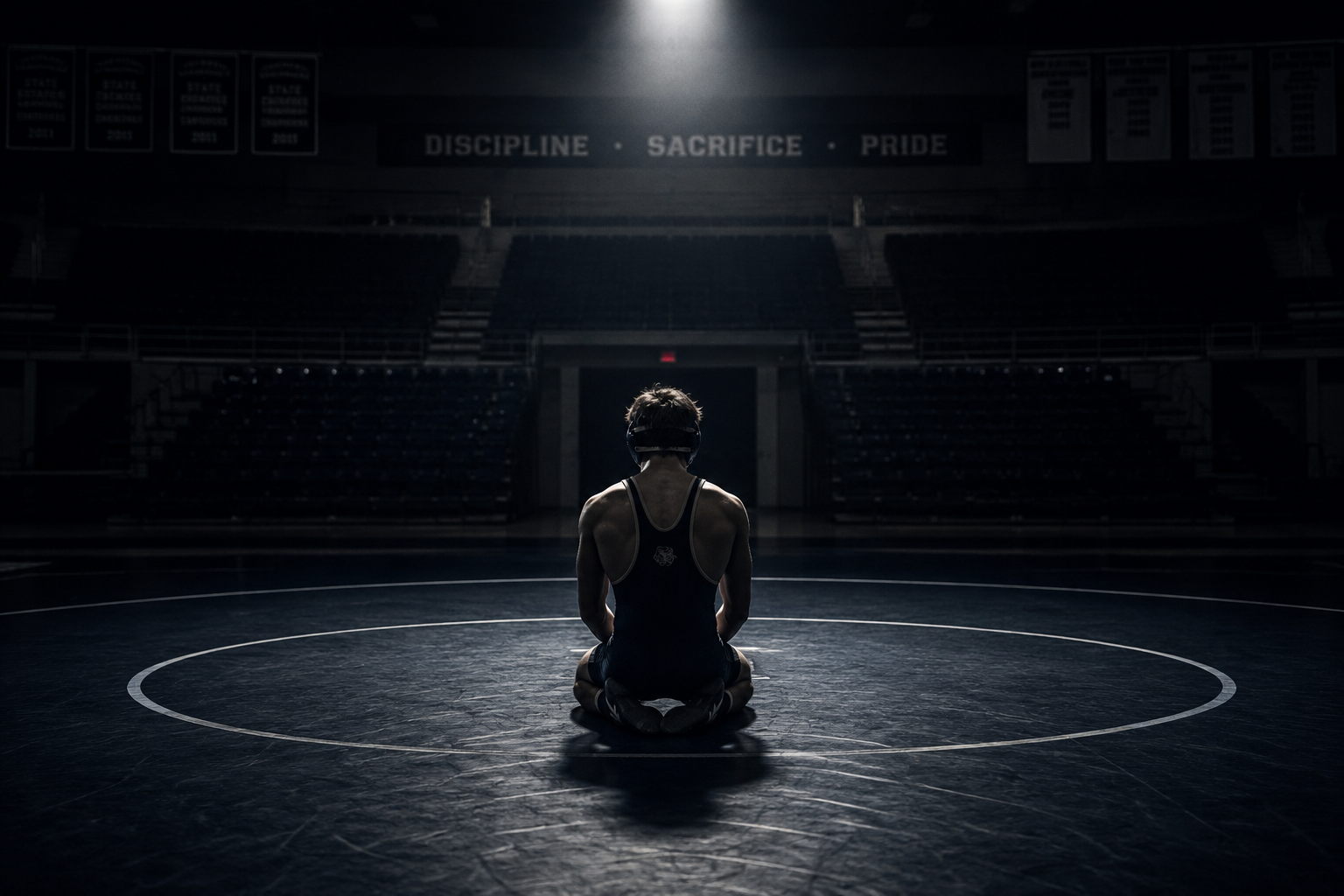
There are no teammates to pass the blame to. No system to lean on. No moment where you can disappear into the flow of the game and hope someone else carries the burden. When a wrestler steps onto the mat, it is a confrontation in its most honest form: one person against another, and more importantly, one person against themselves.
This is what makes wrestling culture so distinct. It is not built around comfort, or even camaraderie in the traditional sense. It is built around accountability.
In most sports, effort can be masked. A missed assignment might be blamed on miscommunication. A loss can be softened by saying, “We’ll get them next time.” But in wrestling, the result is undeniable. You either imposed your will, or you didn’t. You either prepared, or you didn’t. You either broke—or refused to.
That level of exposure forces a different kind of growth. Wrestlers are not just trained physically; they are conditioned to confront discomfort without escape. Early mornings, weight cuts, grueling practices—these are not just rituals of the sport. They are tools designed to strip away excuses and reveal character.
Because when everything is taken away—when there is no crowd noise, no teammates, no distractions—what remains is the truth of who you are.
And that truth can be uncomfortable.
It is also why so many otherwise talented athletes never step onto the mat—or step away from it once they do.
Wrestling does not just test ability; it exposes inadequacy in real time, in front of everyone, with no place to redirect the outcome. For athletes accustomed to environments where performance is distributed, where mistakes can be absorbed by the group, this level of personal accountability can feel overwhelming. The difficulty is not just physical—it is psychological. It demands a willingness to be seen failing, to be defined by effort rather than potential, and to confront weaknesses without protection.
Many are unwilling to do that.
The common explanation is that wrestling is “too hard.” But difficulty alone is not the full story. What makes it unbearable for some is what the difficulty reveals. It strips away identity built on reputation, size, speed, or past success, and replaces it with a simple question: can you endure, adapt, and take ownership when there is no one else to carry you?
For some, the answer is no.
And often, that answer is reinforced—not challenged—by the environment around them.
Too frequently, the first sign of adversity becomes the exit point. Parents, wanting to protect their children from discomfort or failure, provide an immediate alternative: another sport, another path, another excuse. Instead of reinforcing consistency and resilience, they unintentionally validate avoidance. The lesson becomes not how to endure hardship, but how to escape it.
Over time, that pattern compounds. The athlete never develops the capacity to sit with failure, to process it, and to grow from it. Instead, they learn to redirect—to find spaces where their weaknesses are less visible, where accountability is shared, where pressure is diluted.
Wrestling does not allow that.
It forces a confrontation not only with physical limits, but with mindset. It reveals who can absorb failure without breaking, who can return to the same grind after being exposed, and who requires comfort to continue.
In that sense, wrestling is not just a filter for athletes—it is a filter for support systems as well.
Because resilience is rarely built in isolation. It is reinforced—or undermined—by the people surrounding the athlete. When the expectation is consistency, when effort is non-negotiable, when quitting is not normalized, individuals are far more likely to push through the initial resistance. But when the structure around them collapses at the first sign of struggle, so do they.
Wrestling exposes both.
It reveals the natural competitor—the one who leans into adversity, who sees failure as information, who returns sharper after being broken down. But it also reveals those who are unable—or unwilling—to carry the weight of personal responsibility. Those who require external validation to continue. Those who cannot separate discomfort from defeat.
That distinction is not always comfortable, but it is always clear.
And for those who stay, who endure, who accept the terms of the sport, something changes.
They begin to understand that discomfort is not something to avoid, but something to lean into. The grind is not a phase; it is the point. The suffering is not a side effect; it is the forge. Over time, wrestlers develop a relationship with hardship that most people never experience. They begin to understand that growth is not found in ease, but in resistance.
This is why wrestling produces a different kind of confidence. Not the loud, performative confidence that seeks validation, but a quiet, internal certainty. A wrestler knows what they have endured. They know the hours no one saw, the battles fought in empty rooms, the moments they wanted to quit and didn’t. That knowledge cannot be taken away.
And it carries beyond the mat.
In life, there are countless situations where there is no team to rely on—decisions that must be made alone, responsibilities that cannot be delegated, consequences that must be owned. Wrestling prepares individuals for these moments by making them familiar, even routine.
It teaches that pressure is not something to fear, but something to navigate. That failure is not final, but instructive. That discipline is not optional, but essential.
Most importantly, it teaches ownership.
In a world where it is easy to deflect responsibility, wrestling demands the opposite. It demands that you look inward first. That you ask not “Who failed me?” but “Where did I fall short?” That mindset is rare—and incredibly powerful.
Because once a person truly accepts ownership, they gain control. And once they gain control, they gain the ability to change.
That is the essence of wrestling culture.
It is not just about winning matches. It is about building individuals who can withstand pressure, embrace struggle, and take full responsibility for their outcomes. It is about developing people who understand that success is not given—it is earned, alone, in moments when no one is watching.
In the end, wrestling is not just a sport.
It is a mirror.
And for those willing to face what it reflects, it becomes one of the most transformative experiences a person can have.