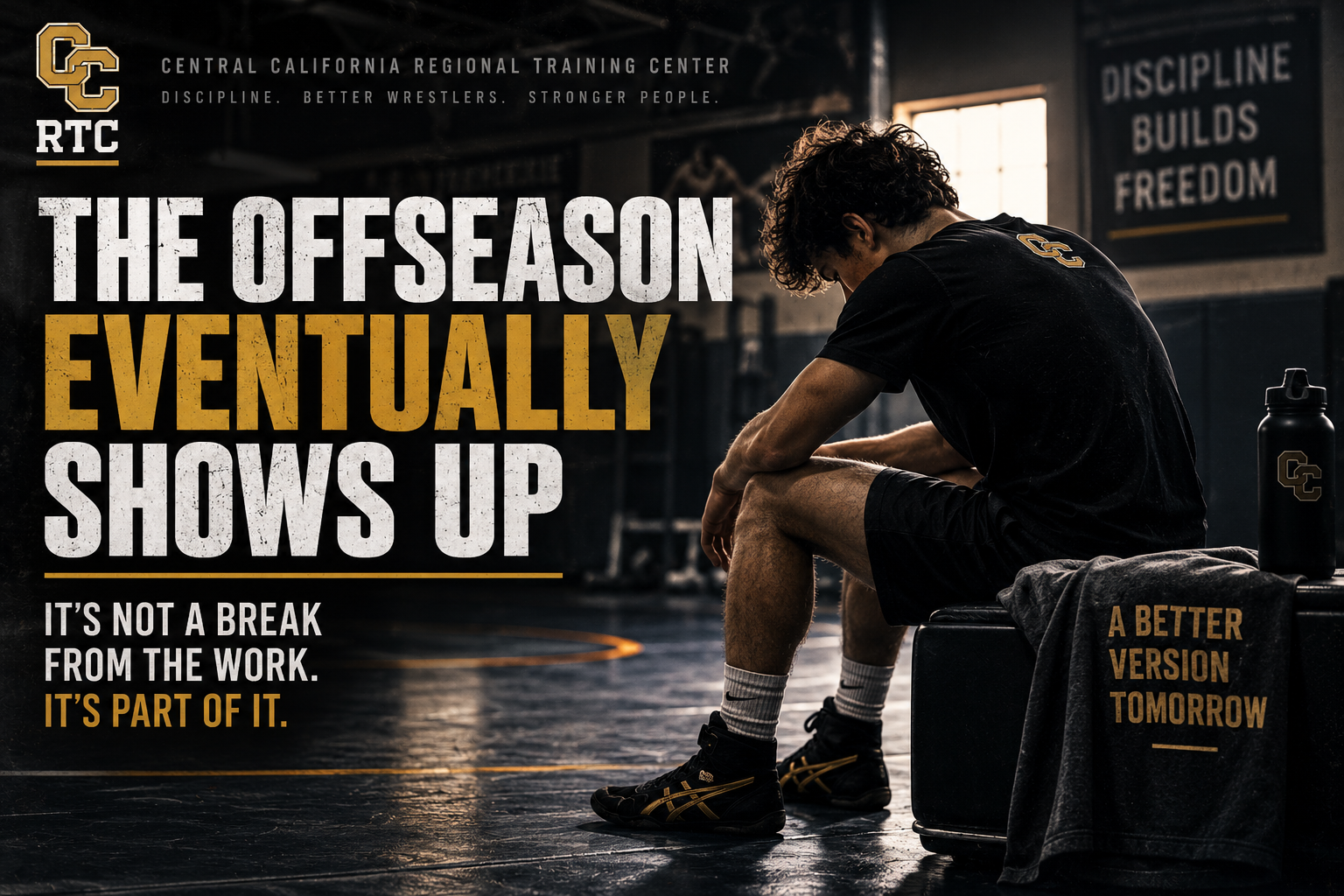
The Offseason Eventually Shows Up
What our first preseason tournament taught us about consistency, competition, parental support, and the work that happens when nobody is keeping score
Our first preseason tournament gave us something coaches spend the entire offseason waiting to see: feedback. Not simply wins and losses, medals, or team points, but our first real opportunity to see what several months of choices looked like when our wrestlers were placed back into competition.
For the most part, what we saw was exactly what we should have expected. The wrestlers who consistently trained through the spring and summer generally showed the greatest improvement. Those who continued competing looked more comfortable in competition. Those who committed to our early-morning strength program often looked physically different in positions that had previously given them trouble.
Some wrestlers seemed to pick up almost exactly where they had left off at the end of last season. Their strengths were still there, but so were many of the same weaknesses. In a few cases, there appeared to be some regression. Timing was not as sharp. Reactions that had become automatic last season required thought again. Positions that had once felt familiar suddenly looked less comfortable.
Other wrestlers looked noticeably different from the athletes we had coached only a few months earlier. They were faster in familiar situations, more comfortable in scrambles, stronger when finishing positions, and generally more composed once competition began.
This was not a scientific study, and one preseason tournament cannot prove that any particular training formula guarantees success. Wrestling has too many variables for that. Still, as coaches, the pattern was difficult to ignore.
The offseason eventually showed up.
There Was Never Going to Be a Reset Button
Young athletes sometimes unconsciously imagine the beginning of a new season as a reset. Last year’s results disappear, everyone reports back to the wrestling room, practices begin, everybody gets back into shape, and then we find out who improved.
Development does not work that way.
The calendar resets. The athlete does not.
If two wrestlers finish a season at roughly the same level and one spends the next five or six months practicing, lifting, competing, making mistakes and correcting them while the other largely steps away, those two wrestlers probably will not remain at the same level when they meet again. One wrestler continued accumulating experience while the other stopped accumulating it.
That does not make the wrestler who took time away a bad teammate or a bad athlete. Young athletes need recovery. Their bodies need rest, their minds need rest, families need vacations, and kids need friends, hobbies and periods when wrestling is not the center of every day.
There is, however, a meaningful difference between taking a break and putting development on hold for most of the offseason.
Our first preseason competition gave us a chance to see that difference.
The 100-Match Challenge
At the end of last season, our coaching staff challenged the wrestlers to pursue a specific goal: 100 competitive contacts before the next season.
Some of our athletes took that challenge very seriously. They found tournaments, competed through the spring, kept competing during the summer, traveled to unfamiliar places and wrestled opponents they had never seen before. A few have approached or surpassed the 100-match mark.
There is nothing magical about the number 100. Match No. 100 does not suddenly unlock some secret level of wrestling ability. The number was a target, and that was intentional.
“Get better this offseason” sounds good, but it is difficult for a teenager to measure. “Try to get 100 competitive matches” gives an athlete something concrete to pursue. Twenty-five becomes forty-seven. Forty-seven becomes sixty-three. Sixty-three becomes eighty-one. Eventually, 100 begins to feel attainable.
The number made the goal tangible.
But the real value of the challenge was never the number itself. It was everything required to pursue it.
The Matches Were the Metric. The Habits Were the Goal.
Nobody accidentally wrestles 100 matches.
To compete regularly, you generally have to practice regularly. You have to remain connected to the sport. You need to know where tournaments are taking place. Someone has to register. Someone has to get in the car. The athlete has to wake up, prepare, compete, discover what worked and what did not, and then return to the wrestling room.
Over time, a developmental cycle begins to form:
- Train. Build technique, strength and conditioning.
- Prepare. Get physically and mentally ready to compete.
- Compete. Test those skills against someone who has no interest in cooperating with the plan.
- Learn. Identify what failed, what succeeded and what needs attention.
- Return. Go back to practice with better information and repeat the process.
Do that enough times and a wrestler is no longer simply accumulating matches. They are accumulating experiences.
He/she encounters different opponents, different body types, different styles and different reactions. They experience good calls and bad ones. They learn what it feels like to score first and what it feels like to fall behind. They have overtime matches, bad first periods, great second periods, disappointing losses and wins they may not have expected. They find positions they had never seen before and then, weeks later, find themselves in the same position again.
Eventually, situations that once felt unfamiliar stop feeling unfamiliar.
That is development.
The 100-match challenge was simply a way to encourage more of it.
Some Wrestlers Were Wrestling Positions. Others Were Remembering Them.
One of the clearest differences we saw at our first tournament involved the speed with which wrestlers recognized and responded to positions.
Experienced wrestlers do not necessarily know dramatically more wrestling than everyone else. Often, they simply recognize wrestling faster.
A developing wrestler reaches a position and has to think, What am I supposed to do here? A wrestler who has accumulated hundreds of repetitions may begin reacting before that question is completely formed.
The difference might only be half a second, but in wrestling half a second can be enormous. A leg disappears. A corner gets turned. A hip gets cleared. An opponent reaches the edge. A scramble changes direction.
That is part of what consistent training and competition produce. Repetition shortens the distance between recognition and reaction.
At our first tournament, some wrestlers were wrestling positions. Others were still remembering them.
That is not an insult. It is information.
The Weight Room Was Part of the Same Story
The athletes who committed to our early-morning lifting schedule were making another type of deposit into their development.
Strength does not replace technique. It supports it.
A wrestler may understand exactly how to finish a position but still lack the physical ability to maintain posture, move an opponent or hold position once fatigue begins accumulating. As strength improves, technique often becomes easier to express. A wrestler who previously understood a finish but could not consistently complete it may suddenly find that the technique works more reliably because his body is now better equipped to perform what his mind already understood.
There is also another benefit to those early mornings that has very little to do with the barbell.
Getting out of bed when you do not particularly feel like getting out of bed is training too. Showing up when there is no crowd is training. Doing something difficult because you committed to doing it is training.
Those lessons eventually follow an athlete onto the wrestling mat.
To the Wrestler Who Put in the Work
If you trained consistently this offseason, you should feel good about what you accomplished.
Not satisfied. Proud.
There is a difference.
Maybe you woke up early when you would rather have slept. Maybe your friends were doing something else while you were at practice. Maybe your parents drove you two hours to a tournament where you went 1–2, and then everyone got back in the car and drove home.
Maybe you traveled somewhere the following weekend and went 4–1. Maybe you lost to someone in April and beat that same wrestler in July. Maybe nobody other than your parents and coaches noticed any of it.
We noticed.
More importantly, your wrestling noticed.
The work accumulated.
Your first preseason tournament was not the beginning of that improvement. It was simply one of the first places where everyone else could see it.
You should take some pride in that. Then keep going.
To the Wrestler Who Knows They Could Have Done More
There were also wrestlers who probably watched this tournament and recognized something uncomfortable.
They know they could have trained more. They know how many practices they missed. They know whether the alarm went off and they rolled over. They know whether they talked about competing more than they actually competed. They know whether they intended to have a great offseason but kept assuming there would always be another practice, another tournament or another week to get serious.
There is no benefit in pretending otherwise.
There is also no benefit in shame.
The purpose of looking backward is not to punish yourself for what you failed to do. It is to make a more intelligent decision about what you do next.
You cannot attend a practice from June. You cannot wrestle a tournament that happened in July. Those opportunities are gone.
But the season has not started yet.
There are still a couple of months available, and a couple of months can contain a tremendous amount of work. There are still many practices, many mornings, many lifting sessions, many live goes and many opportunities to begin creating different habits.
The lesson from this tournament should not be, I’m behind, so it’s too late.
It should be, Now I can see what consistency produces. I still have time to start producing it.
Parents Are Part of This Too
There is an uncomfortable reality in youth and high-school athletics that we sometimes avoid discussing: teenagers are not finished products.
We regularly ask young people to make decisions that require a level of long-term thinking they are still learning to develop. An adult can understand that getting out of bed at 5:30 on a June morning may have consequences in February. A 15-year-old may understand exactly the same thing intellectually and still strongly prefer staying underneath the covers.
Sometimes the athlete wakes himself up.
Sometimes a parent has to turn on the light.
That does not automatically mean the parent wants wrestling more than the child does.
There is a healthy middle ground between dragging a child through a sport they have no desire to participate in and expecting an immature teenager to independently possess every habit and every form of discipline that we hope they eventually develops.
Parents provide structure in almost every other part of adolescence. We make kids attend school. We expect homework to get done. We establish curfews. We teach them to arrive on time and fulfill commitments.
We do not do those things because we expect to control them forever. We do them because part of parenting is providing structure while habits, judgment and independence are still developing.
Sports can work the same way.
Sometimes the parent’s role is simply to remind the young athlete of a commitment they made: You told me this matters to you. Practice starts in an hour. Get up.
Eventually, ideally, the parent no longer has to say it.
The athlete gets himself up.
That transition is part of growing up.
Support Is Different From Ownership
There is also an important boundary for parents to understand.
A parent can provide the ride. A parent can pay the entry fee, make breakfast, register for the tournament, remind the athlete about the commitment they made and, occasionally, turn on the bedroom light.
But at some point, the wrestler still has to wrestle.
The goal is not to create an athlete who performs only because Mom or Dad is constantly pushing from behind. The goal is to help a young person develop enough consistency that external accountability gradually becomes internal discipline.
Early in that process, the athlete may think, My parents make sure I go.
Eventually, we want the thought to become, I go because this is what I do.
That transformation rarely comes from one inspirational speech. It happens through repetition.
Habits are built from consistent actions, and consistent actions are not always things teenagers naturally choose when the alternative is easier.
Sometimes discipline begins as borrowed structure.
Eventually, we hope, it becomes ownership.
Coaches Have a Responsibility Too
This reflection is not only for athletes and parents. Coaches have to look at ourselves as well.
Because we believe offseason training matters, we have done our best to provide meaningful opportunities to train. If we tell athletes that competition matters, we try to help them understand where to compete and why those experiences are valuable. If we ask families to sacrifice mornings, weekends, entry fees and travel, then the environment we provide should justify that investment. As coaches, we love the sport so much and are giving up our time because we passionately believe in what it does for the human soul to sacrifice, suffer, and come out the other side an improved person.
And when athletes do show up, we love it and give of ourselves to coach them.
The answer to development cannot simply be “work harder.” Young athletes need to understand what the work is intended to produce.
The 100-match challenge was one way of doing that. It gave our wrestlers something measurable and gave families something concrete to work toward. Now the preseason gives us an opportunity to reflect on what that measurement actually represented.
It was never just 100 matches.
It was 100 opportunities to prepare, compete, learn and return.
This Tournament Was a Checkpoint, Not a Verdict
That distinction may be the most important one.
Nobody won a championship this weekend that determines what will happen at the end of the season.
Nobody lost one either.
September is not February.
An athlete who had an outstanding spring and summer can still become complacent. A wrestler who had an inconsistent offseason can still change dramatically over the next several months.
The preseason tournament gave us a snapshot.
For some wrestlers, that snapshot said: Keep going. What you’re doing is working.
For others, it said: You have some catching up to do.
Both are useful messages.
Neither determines what happens next.
What Happens From Here Is Still a Choice
A wrestler who recognizes that they fell short of their offseason goals now has a decision to make.
They can spend the next two months defending the choices they already made, or they can make different ones.
That does not require a dramatic announcement. It does not require a social-media declaration that everything is about to change. Most meaningful change is far less exciting than that.
It looks like coming to practice.
Then coming again.
It looks like getting into the weight room, finding competition, asking questions, staying for another live go, correcting the position that keeps costing points, going home, recovering and returning the next day.
It is Tuesday morning.
Then Wednesday.
Then Thursday.
It is doing what you said you were going to do often enough that eventually doing it stops feeling exceptional and starts feeling normal.
That is how habits are built.
The Offseason Eventually Shows Up
Our first preseason tournament reinforced something coaches have always believed but athletes sometimes need to experience for themselves.
The work shows up.
So does the absence of it.
That does not happen perfectly, immediately or in every individual result. A hardworking wrestler can lose. A wrestler who trained very little can win. Talent matters. Matchups matter. Experience matters. Physical maturation matters. Sometimes one kid simply has a better day than another.
There will always be exceptions.
But over time, consistency has a way of revealing itself.
The athlete who trained all spring and summer did not suddenly improve when they stepped onto the mat at our preseason tournament. They had been improving quietly for months. The tournament simply made some of that work visible.
The same principle applies in the other direction.
That should not leave anyone ashamed.
It should leave us informed.
For the wrestlers who answered the 100-match challenge, kept training, woke up early and consistently got themselves into the room, take some pride in what you built. You earned the right to see progress.
For the wrestlers who know they left opportunities unused, acknowledge it. Not as punishment and not as an excuse to question whether you belong. Acknowledge it because honesty about where you are is the first requirement for changing where you are going.
For the parents who spent months waking teenagers, driving to practices, sitting in gyms, paying tournament fees and sometimes pushing a young athlete through the door on a morning when motivation was not there, understand that some of what you were helping build may have been bigger than wrestling.
You were helping establish the habit of showing up.
Eventually, that habit has to belong to the athlete. That is part of the process too. But sometimes, before a young person learns how to consistently get himself out of bed, someone who loves him has to turn on the light.
There is still time before the season.
What happened this spring and summer has already given us some information. Our first preseason tournament offered a glimpse of the choices that were made and the habits that were built.
Now comes the more important part.
What are you going to do with the time that remains?