Feed the Goal – Part 8: Supplements
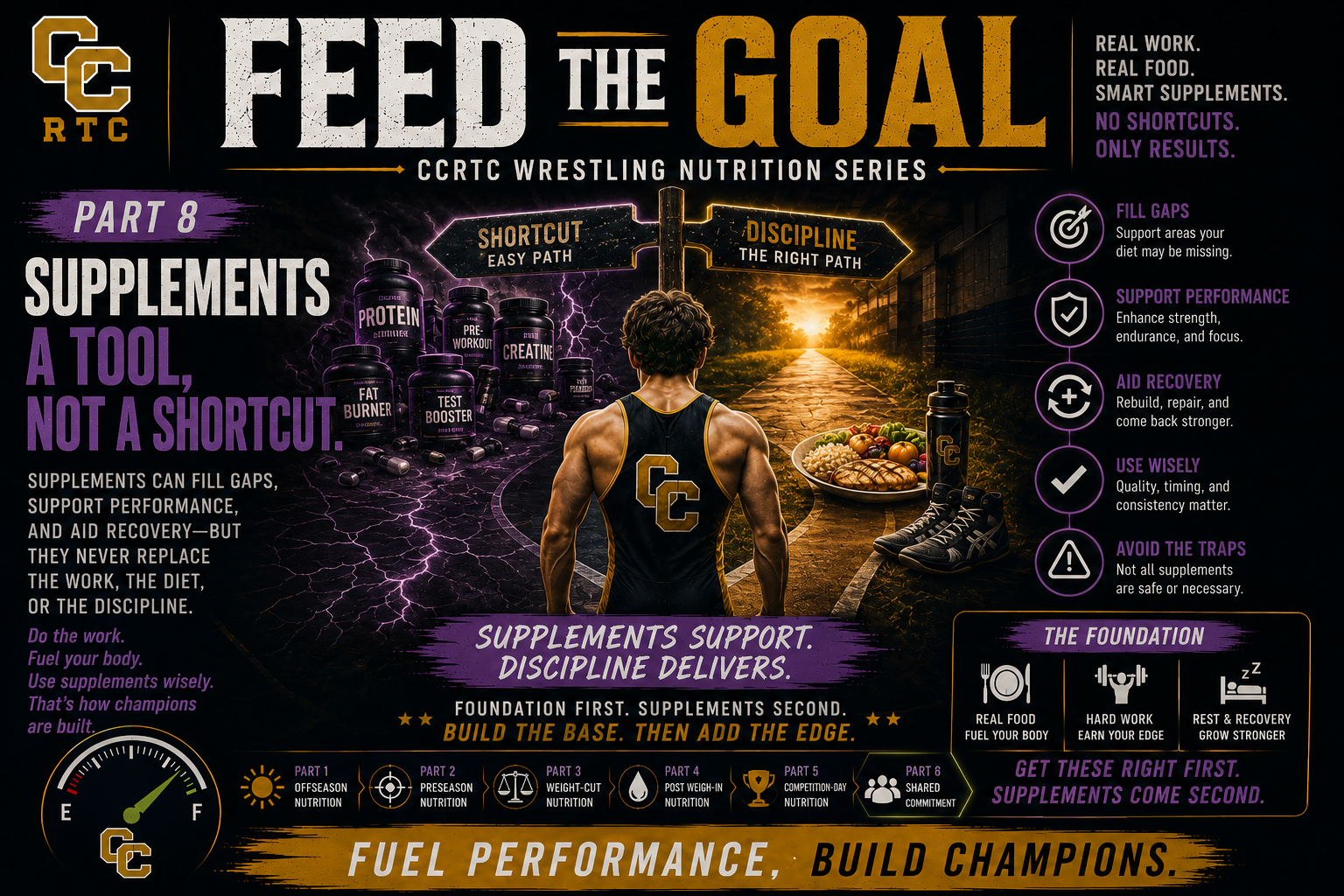
Food First, Supplements Second
By the time wrestlers begin taking their nutrition seriously, it is only a matter of time before they start asking about supplements.
Should I take protein powder?
What about creatine?
Are pre-workouts worth it?
Do I need electrolytes?
Which supplements actually work?
These are reasonable questions. After all, the supplement industry is filled with promises. Social media is saturated with influencers promoting powders, pills, drinks, and gummies that claim to increase strength, accelerate recovery, and provide a competitive edge.
The truth is that supplements can be helpful.
But they are not magic.
Throughout this series, we have repeatedly emphasized the fundamentals. In Part 1, we discussed building the wrestler through proper nutrition. In Parts 2 through 5, we focused on fueling the body for competition. Part 6 explored the importance of support systems, and Part 7 reminded us that hydration itself is performance.
Supplements do not replace any of those things.
They supplement them.
Build the Foundation First
One of the most common mistakes athletes make is trying to supplement their way around poor habits.
No amount of powder or pills can compensate for:
- Poor sleep.
- Inadequate hydration.
- Inconsistent eating habits.
- Lack of recovery.
- Skipping meals.
- Poor weight management.
Supplements should be viewed as additions to an already strong foundation.
Not substitutes for one.
The greatest performance enhancers available to wrestlers remain remarkably simple:
- Consistent training.
- Proper nutrition.
- Adequate hydration.
- Quality sleep.
- Recovery.
Those habits are available to every athlete, and they outperform expensive supplements every single time.
Supplements Are Tools, Not Lifestyles
Unlike healthy eating and hydration, supplements are not necessarily permanent fixtures.
Most nutritional habits should remain year-round. Protein-rich foods, proper hydration, fruits, vegetables, and healthy fats should never disappear.
Supplements, however, are tools. Like any tool, they are used when appropriate and set aside when they are not.
For example, creatine supplementation may be beneficial during periods of heavy strength training and muscle development. However, some wrestlers may choose to discontinue creatine temporarily when body weight management becomes a concern due to the increased water retention within muscle cells.
Likewise, sports drinks may be invaluable during tournament weekends and summer camps but unnecessary during ordinary school days.
Context matters.
There are very few supplements that every athlete needs, every day, throughout the year.
Protein Powder: Convenience, Not Magic
Protein powder is perhaps the most widely used supplement among athletes, and for good reason.
It is convenient.
It is portable.
It helps busy athletes meet their protein requirements.
But it is important to remember that protein powder is simply food in powdered form.
It is not superior to:
- Lean beef.
- Chicken.
- Eggs.
- Fish.
- Greek yogurt.
- Cottage cheese.
- Milk.
Whenever possible, whole foods should remain the priority.
Protein shakes are best viewed as a convenient backup plan rather than a replacement for meals.
The goal is not to drink your nutrition.
The goal is to make good nutrition easier.
Creatine: The Most Studied Supplement Available
Few supplements have been researched as extensively as creatine.
Decades of scientific study have consistently shown benefits for:
- Strength.
- Power production.
- Recovery.
- Repeated high-intensity efforts.
Creatine is not a steroid.
It is naturally present in foods such as red meat and fish and plays an important role in the body’s energy systems.
For most wrestlers, a simple daily dose of 3 to 5 grams is sufficient. Loading phases are unnecessary.
One common misconception is that creatine causes dehydration. In reality, creatine increases water storage inside muscle cells and has not been shown to impair hydration when athletes maintain proper fluid intake.
As we discussed in Part 7, hydration remains critical.
Some athletes may choose to discontinue creatine during periods where managing body weight becomes particularly important. That decision should be made thoughtfully, recognizing that supplements are tools, not obligations.
Fish Oil and Vitamin D
Many athletes do not consume enough fatty fish or spend enough time outdoors to maintain optimal levels of omega-3 fatty acids and vitamin D.
These nutrients support:
- Bone health.
- Immune function.
- Recovery.
- Brain health.
Whenever possible, food should come first.
However, supplementation may be appropriate for athletes whose diets or lifestyles make deficiencies more likely.
Blood testing and physician guidance are often helpful when considering vitamin D supplementation.
Electrolytes and Sports Drinks
As discussed in Part 7, hydration involves more than water.
Electrolytes become increasingly important during:
- Long practices.
- Summer camps.
- Multi-day tournaments.
- Hot environments.
Likewise, sports drinks have their place.
They are tools.
Not necessities.
Most everyday hydration needs are easily met with water and normal meals. However, periods of prolonged exercise or repeated matches may benefit from additional carbohydrates and electrolytes.
The goal is not to consume sports drinks constantly.
The goal is to use them when they serve the purpose.
Caffeine and Pre-Workout Products
Perhaps no category of supplements is more misunderstood than pre-workout products.
Most are little more than expensive caffeine delivery systems.
While caffeine can improve:
- Alertness.
- Focus.
- Endurance.
It also carries risks.
Excessive caffeine may contribute to:
- Anxiety.
- Elevated heart rate.
- Poor sleep.
- Dependency.
No supplement should interfere with sleep.
Ever.
Sleep is still the greatest recovery tool available to wrestlers, a topic we will explore in Part 9.
Young athletes should be especially cautious with pre-workout products, many of which contain proprietary blends and stimulant combinations that are poorly regulated.
Save Your Money
The supplement industry thrives on promises.
Many products simply are not worth the cost.
Generally speaking, wrestlers should avoid:
- Testosterone boosters.
- Fat burners.
- Detox products.
- Most BCAA supplements.
- Proprietary blends.
- “Miracle” products.
No pill replaces:
- Discipline.
- Time.
- Training.
- Recovery.
- Patience.
Parents Hold the Purse Strings
Young wrestlers are constantly exposed to advertisements promising shortcuts.
Fortunately, parents hold one of the greatest forms of influence.
They control the credit card.
Before purchasing any supplement, parents should ask:
- Is this solving a real problem?
- Are we trying to replace a habit?
- Would the money be better spent elsewhere?
In many cases, investing in:
- Better food.
- Wrestling camps.
- Travel opportunities.
- Recovery.
- Sleep.
- Coaching.
Will provide far greater returns than another container of powder.
Parents should not feel pressure to buy every product their athlete sees on social media.
The fundamentals remain undefeated.
Common Supplement Myths
Like hydration, supplements are surrounded by misconceptions.
Myth: If elite wrestlers take it, I need it.
Elite athletes succeed because of years of training, not because of a particular powder.
Myth: More is better.
More is rarely better.
More is often expensive.
Sometimes it is dangerous.
Myth: Supplements are shortcuts.
They are tools.
Nothing more.
Looking Ahead
The truth is that many athletes spend more time researching supplements than they do prioritizing recovery.
Yet growth does not occur during practice.
Growth occurs afterward.
In Part 9, we’ll discuss perhaps the most overlooked performance enhancer available to wrestlers:
Recovery.
Because the body grows stronger between practices, not during them.
Feed the Goal
Champions are not built in supplement stores.
They are built through habits.
Eat well.
Hydrate consistently.
Sleep deeply.
Recover intentionally.
Then, if appropriate, use supplements to supplement.
Not substitute.
Feed the goal.






One Comment