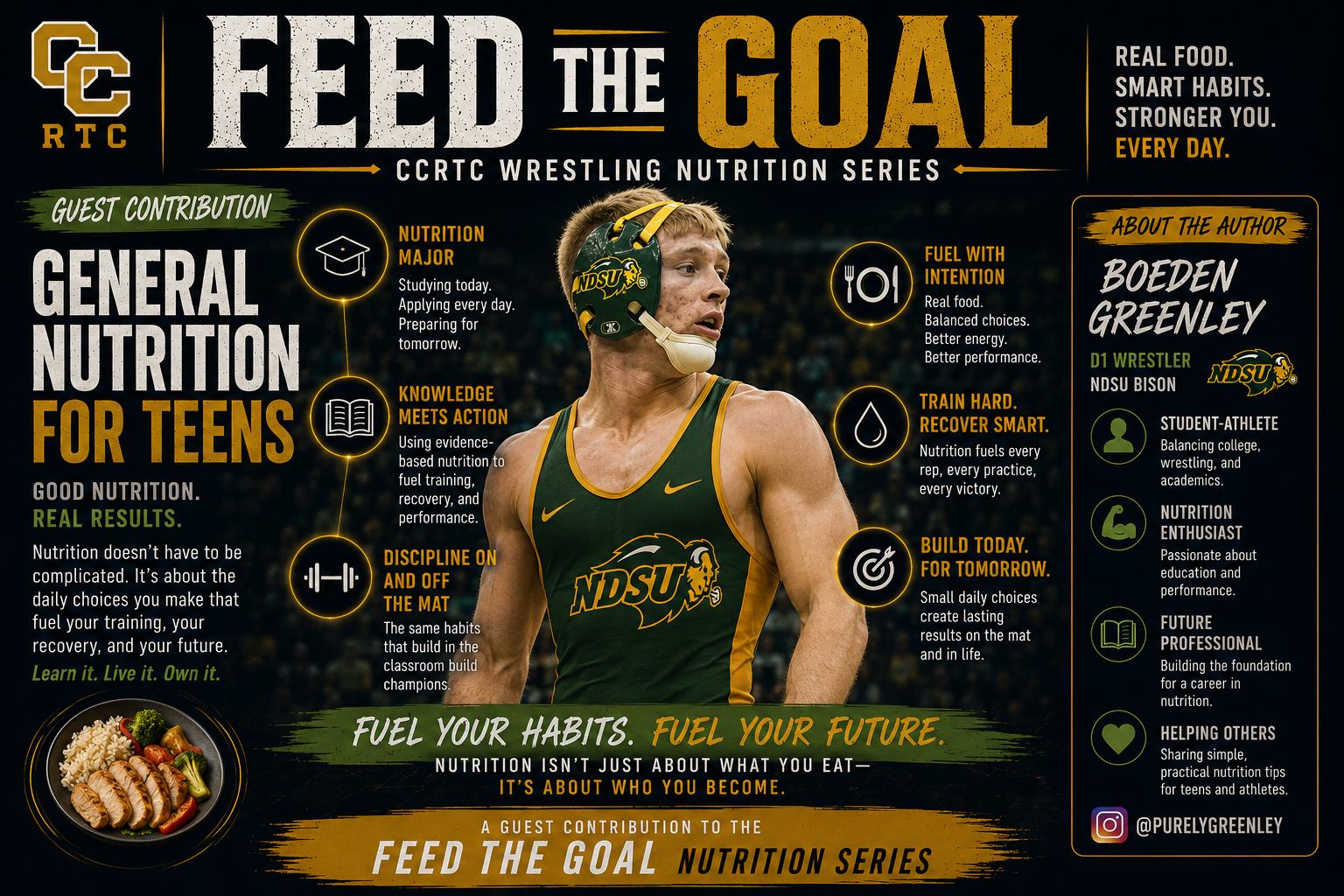
Feed the Goal – Special Feature: General Nutrition for Teens (Guest Article)
When I think nutrition for teens a few things immediately jump to my mind. Understanding maintenance calories, eating enough food, the proper food, and the timing of food. Before I dive into those things specifcially a couple non-food specific things that are very important. 8-9 hours of sleep every night consistently. Waking up and going to bed at roughly the same time. As well as adequate hydration. Shooting for your bodyweight in pounds times 0.6 in fluid ounces every day. Plus 1lb of fluid for every pound lost during a workout.
Now lets dive into food specifically, understanding your maintenance calories is one of the most powerful things any athlete can do. You certainly do not need to track and weigh all of your food forever, but doing it for even a week can really help anybody understand roughly what they need to eat to maintain their weight. Once you understand that it becomes a very simple game to either put on weight or lose it.
Next lets tackle eating enough food, the proper food, and the timing of the food. These things all work together hand in hand. For teens above almost any other age group it is so important to eat enough food as this is the growing stage of their lives. Not eating enough will certainly stunt growth and decrease bone density leading to problems down the road. In my eyes eating enough food is at least 3 meals and 1 snack. With bumping either meals or snacks up being no problem. For meals a performance plate is the best structure to follow put simply. Half the plate starchy carbohydrate like a potato, quarter of the plate a lean protein like chicken breast, the other quarter being one fruit and one vegetable, and the meat being cooked in fat such as olive oil.
Following this structure allows you to hit not only your calorie needs but your micro-nutrient needs as well. Timing the food is important as well. Anytime you eat a meal you want atleast 3 hours until you workout to digest that meal. Then we have snacks, you can eat a snack pre workout or post workout. Before a workout you want a carb heavy snack. Fruit, rice cakes, honey, maple syrup, and even candy are all good options. After a workout think more protein. Beef sticks, chocolate milk, protein shakes, and protein bars are all good options.
Try to avoid highly processed food on a regular basis. There is no issue getting ice cream with friends here and there, but consistently following the above format is important. Following the above habits leads to better sleep, better recovery, less injuries, more power, and ultimately winning more.
Off Season
The off season is a great opportunity for tons of wrestlers. The problem is so many cut too much weight in the season and enter this viscous cycle where they eat anything and everything in the off season and get really fat.
Maintenance calories again is a great concept to understand for the off season. When you are trying to put on the right type of weight (lean muscle mass) the same things that are important in the season are just as important.
Sleeping 8-9 hours, hydration and nutrition being at the top of the list. If you know your maintenance calories, you want to enter into a 10-15% calorie surplus. Consistency is key here. A couple other key factors are eating 0.7-1g of protein per lb of bodyweight and 0.4-0.5g of fat per pound of bodyweight.
Combine those nutrition, sleep, and hydration habits with a resistance training program that pushes you hard and you can put on a lot of muscle mass in not a ton of time.
One more thing to touch on here is creatine. Creatine can be extremely beneficial specially in the off season IF those other factors are all dialed in. 5g per day is plenty to receive adequate benefits.
The off season is a time to gain legitimate muscle mass. Not get as fat as possible!
Fueling During Competition
Fueling during competition is just as, if not more, important than fueling your body at any other time. The name of the game here is carbs, fluids, and salt.
Your body can process 2lbs of fluid every hour. So this is the maximum amount of fluid you can intake before and in between matches. This intake process can really vary between athlete but aiming for atleast your baseline on the day of 0.6 times your bodyweight in lbs of fluid ounces.
Combine those fluids with salt. Salt again is something that really varies between athlete but a good baseline is 2500-4000mg per day total. Taking that in increments of 500-1000mg with the fluid is best practice.
Last but not least we have carbohydrates. Rocket fuel and essentially the only energy your body can process fast enough to be useful in between matches. 1g of carb per minute in between your match is the magic number. Steer clear of fat and fiber. You can add small bout of protein if you have 2 hours or longer between your match. About 10g of protein for every hour you have is good here.
A carb snack example for 60 minutes would be a banana and 2 tablespoons of honey. An example for 120 minutes would be a whole bagel with 2 tablespoons of jelly and an orange.
It is so vitally important to only eat what you need not what you want. To have energy and not feel bogged down is the goal. It also makes making weight for day 2 so much easier!
Making Weight
When it comes to making weight in the short term understanding a few key concepts will make all the difference. Fiber, sodium, and food weight are the big ones.
It is very important to note here that we are not losing fat, we are simply manipulating the scale short term in the form of the amount of food and water in your body. The three earlier factors will be the best ways to lose weight quickly without majorly impacting performance. These tactics will all be performed 72 hour or closer to weigh-ins.
Let’s start with fiber. Fiber 95% of the time is a phenomenal thing. It is found in most fruits, veggies, and whole grains. It is very beneficial for your gut health but in the short term retains water in your large intestine. Look to flush water out of your body by eating 5g of fiber or less 72 hours leading up to weigh-ins. Expect to lose 1-3lbs here.
Next we have sodium. Sodium is the primary electrolyte that pairs with water to contract your muscles. However it retains water which we can reduce to bring the scale down. 48 hours from weigh-ins eat only Whole Foods and add no additional salt to them. Simply eat them plain. Combine this tactics with taking 1000-2000mg of potassium to help balance the electrolytes within your body. Expect to lose 1-3lbs here.
Lastly we have food weight. This is the most powerful tactic when it comes to losing weight in the short term and fortunately it is very simple. If on a typical day you eat 3 regular meals that may be a total of 4-7+ lbs of food weight. By reducing to very calorie dense foods such as protein bars, nut butters, oils, candy, rice cakes, and honey you can lose a ton of weight. Expect to lose 1-5+ pound by using this. Varies a lot by athlete.
Leaning on these tactics instead of simply working out more or drinking less water will lead to much better performances and predictable weight loss!
– Boeden Greenley
To join my weight cutting/nutrition community:
https://www.skool.com/the-greenley-way/about?ref=6c976677ef754366b4d024ff79a3cacc
Editor’s Note:
Coach Jonno here. Boeden is a great resource for anyone who wants to really dial in their nutrition goals. I know of many athletes who get snippets of his wisdom from his Instagram but his real value comes from his guidance tailored just for you. He is recommended.