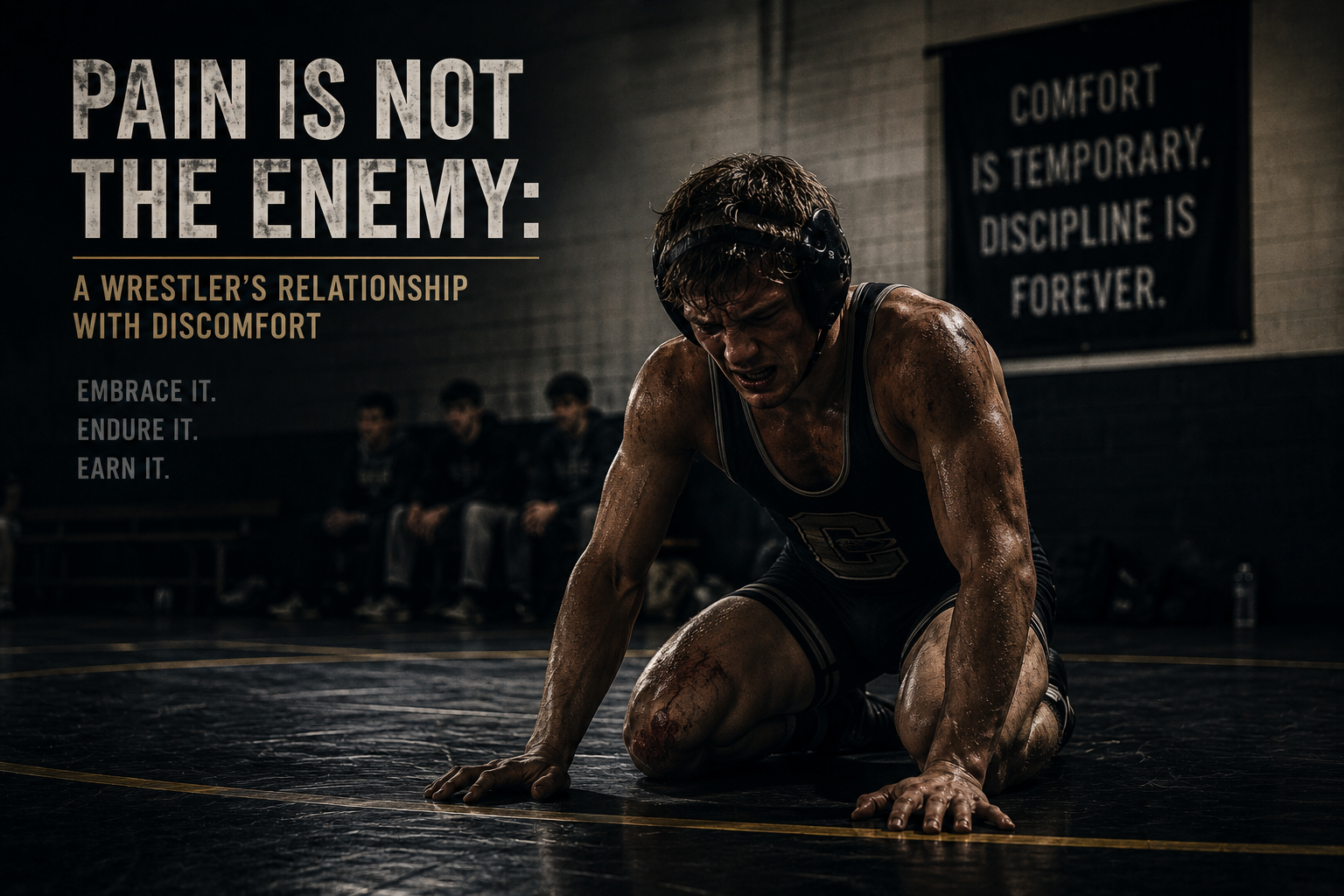
Pain Is Not the Enemy: A Wrestler’s Relationship With Discomfort
As a coach and trainer who has spent years working with high-level wrestlers, I’ve seen one defining trait separate the good from the truly great: their relationship with pain. Not injury—pain. There’s a difference, and understanding that difference is where performance ceilings begin to break.
Most athletes are taught, explicitly or implicitly, to avoid pain. It’s human nature. Pain signals danger, and our brain is wired to protect us. But here’s the reality: if your goals are higher than what your mind can currently comprehend, then your current perception of pain is not a reliable guide. It’s a limiter.
Pain vs. Injury: Know the Difference
One of the most critical skills a wrestler can develop is the ability to distinguish between pain and injury. Injury is structural—something is damaged, compromised, or at risk of getting worse. Pain, on the other hand, is often just your body reacting to stress, fatigue, inflammation, or adaptation.
The problem is that discomfort feels urgent. It demands attention. A burning muscle, tight joints, soreness from the day before—it all feels like something is wrong. But more often than not, what you’re feeling is your body changing, not breaking.
Wrestlers in particular struggle with this because the sport is inherently uncomfortable. You’re cutting weight, pushing your gas tank, grinding through practices, and constantly dealing with physical contact. Recovery doesn’t feel good. Growth doesn’t feel good. And because of that, many athletes subconsciously start to associate discomfort with danger.
That’s where they get stuck.
The Mind’s Ceiling
Your mind is always trying to keep you within familiar limits. It doesn’t know your long-term goals—it only knows what you’ve already experienced. So when you start pushing beyond that, it sends signals: slow down, stop, this hurts, this isn’t sustainable.
But greatness lives beyond that ceiling.
If you only train when you feel good, when your body is fresh, when everything is comfortable—you’re training your mind to expect ideal conditions. Wrestling doesn’t offer that. Championships are won when you’re tired, sore, slightly off, and still able to perform.
The athletes who separate themselves are the ones who can say: “This is uncomfortable, but I’m still capable.”
Recovery Pain Is Not Weakness
A major misconception I see—especially in wrestlers—is confusing recovery discomfort with inability. After a hard session, your body is going to be sore. Your legs will feel heavy. Your shoulders might ache. Your lungs won’t feel as sharp.
And too often, athletes interpret that as: “I can’t go today.”
In reality, that’s often when the most important work gets done.
There is a level of training that only happens when you’re not at 100%. That’s where resilience is built. That’s where your body learns efficiency. That’s where your mind learns control under stress.
If you avoid those moments, you’re not just avoiding discomfort—you’re avoiding development.
Finding the Balance
Now, pushing through pain does not mean being reckless. High-level athletes don’t ignore their bodies—they understand them.
You have to develop awareness:
- Is this sharp, worsening, and localized? Or is it dull, consistent, and manageable?
- Does it limit function, or just make things uncomfortable?
- Does it improve as you warm up, or get worse with movement?
There is a balance between discipline and intelligence. The best wrestlers don’t blindly push—they assess, then push anyway when it’s appropriate.
That balance is what allows longevity and greatness.
Expanding Your Capacity
Every time you push through discomfort—real, controlled, non-injury pain—you expand what your mind believes is possible.
What used to feel unbearable becomes manageable.
What used to stop you becomes something you move through.
And over time, your “normal” shifts.
That’s the process:
- Feel discomfort
- Recognize it’s not injury
- Continue anyway
- Realize you’re still capable
- Raise your standard
Repeat that enough times, and you build a mindset that doesn’t break under pressure.
The Competitive Edge
In wrestling, matches are rarely decided by technique alone at the highest levels. They’re decided by who can execute when everything hurts.
Who can take a shot when their legs are dead.
Who can hand fight when their arms are burning.
Who can stay mentally composed when their body is begging them to stop.
That’s not talent—that’s trained tolerance.
Final Thought
If your goals are truly high—higher than what your current mind can even fully grasp—then you cannot rely on comfort as your compass.
Pain will be part of the process. Discomfort will be constant. And your ability to correctly interpret and push through it will determine how far you go.
You don’t need to be fearless. You need to be accurate.
Not all pain is danger.
Not all discomfort is a stop sign.
Sometimes, it’s just the doorway to the next level—and most people turn around before they ever walk through it.